
This page explains how to use Turnitin on Canvas. Turnitin is already enabled on the whole Stan State account and does not need to be turned on individually by instructors.
Account Note: A Turnitin instructor account is automatically created the first time you access the tool in Canvas. When used with Canvas, no special password for Turnitin is needed. Also, students are automatically identified via Canvas and do not need special accounts to submit assignments to Turnitin.
Aspects of Turnitin
For the Fall 2026 semester, OAT is continuing a campus-wide pilot of Clarity, a new product from Turnitin. All instructors are welcome to register for the information session and training:
Thursday, August 13 @ 1 pm (recording provided)
What is Clarity?
Turnitin Clarity gives instructors visibility into the student writing process, from first draft to final submission. Rather than just turning in a finished document created outside the LMS, students use the Clarity writing space to do their composition, editing, and submission. Akin to Microsoft Word or Google Docs, Clarity's text entry interface contains standard writing and formatting tools. Instructors can also enable/disable grammar and punctuation checking and citation formatting assistance.
Importantly, Clarity is not a "lockdown" environment. Instead, students' work in Clarity is saved automatically and they can return to the assignment as often as needed until the Due Date passes.
Clarity also allows instructors to guide students toward responsible use of A.I. in order to help them improve their writing. When enabled on an assignment by the instructor, the A.I. chat assistant is trained to guide rather than simply provide answers, to provide feedback to students on their progress based on a supplied rubric or help brainstorm topics and structure an outline. The A.I. assistant can also be limited to helping with grammar and citation.
Clarity's writing reports to instructors include insights into the student's writing process as well as flags for further review, such as the appearance of pasted text coming from outside the document. Instructors can also play back the version history of the document to gain visibility into the evolution of their students' writing. Any A.I. chat activity is included in the report along with Turnitin's existing similarity score and A.I. writing score. Additionally, the writing reports also provide peace of mind for students that there is data to show the originality of their work.
Instructor Resources
- Introduction to Turnitin Clarity’s Student Writing Assignment
- Creating a Student Writing assignment
- Reviewing Student Writing assignments
- FAQs for Instructors
The Clarity Pilot
Clarity is available in every course in Canvas right now, accessed as part of the Turnitin toolset found on the Assignments home page.
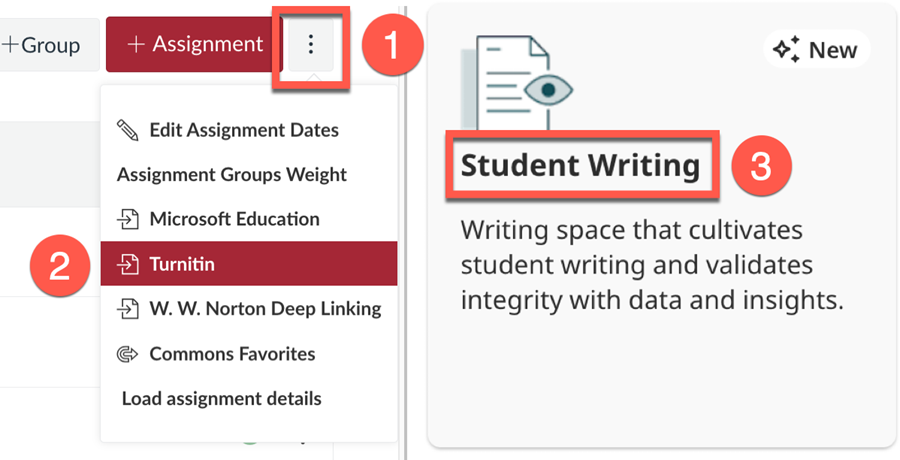
The pilot will last until the end of the Spring semester with feedback gathered in order to guide the possible future licensing of the tool. Interested faculty are therefore invited to assign at least one writing assignment using the Clarity interface. Information on providing feedback will be announced at a later date.
Questions? Contact OAT!
Instructors can choose to enable basic Turnitin plagiarism checking on any regular Canvas assignment. This method is very streamlined to set up but does not have more advanced features of Turnitin. For information about more advanced use of Turnitin, skip to the next section of this page.
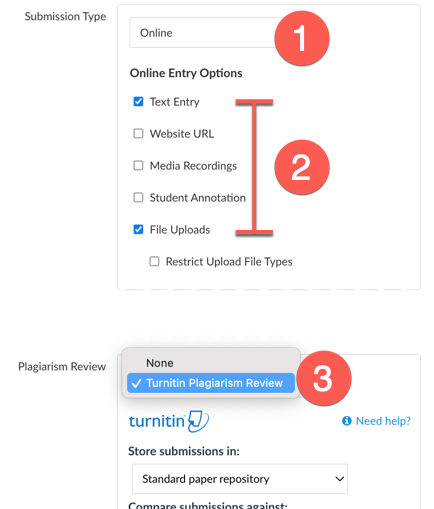
First, go to the Assignment and begin configuring it as normal. Adjust the following settings:
- Open the Submission Type menu and select Online
- Choose Text Entry and/or File Uploads as the Online Entry Options. Turnitin will only work with one of those options selected. You can choose additional Online Entry Options, but the only options that Turnitin can evaluate are Text Entry and File Uploads.
- From the Plagiarism Review menu, choose Turnitin Plagiarism Review
Next, configure the rest of your optional assignment details such as the Due Date and the Until date (Until is the cut-off date). Click Save or Save and Publish.
Assignment Rubrics and Student Workflow
To use a Canvas rubric during assessment, click +Rubric on the assignment overview page and set up the rubric normally.
Reviewing and Grading Submissions
For basic plagiarism checking, all reviewing, annotation, and grading occurs within SpeedGrader.
- Open the student's submission in SpeedGrader
- Open the originality report for the submission by clicking the colored originality score icon
- Use SpeedGrader's built-in annotation tools to mark up the student's document, if desired
- Input a grade directly in SpeedGrader
This method uses the Turnitin External Tool to connect a Canvas assignment to Turnitin. In this method, the instructor has access to a more advanced Turnitin interface. For example, in addition to a specialized Assignment Inbox, this method allows the instructor to mark up and grade submissions using Turnitin's full Feedback Studio.
On December 1, OAT enabled an upgraded Turnitin experience in all Canvas courses. The new interface only affects newly created Turnitin assignments and copied assignment in new courses. Existing assignments at the time of the update will not be affected.
Frequently Asked Questions
How do I create a Turnitin assignment?
In the updated method, instructors create Turnitin assignments from the 'three-dot' menu of the main Assignments home page, as shown below.

Step 1: Click the 'three dot' menu on the Assignments home page of the course. It's no longer necessary to click "+ Assignment" to create full Turnitin assignments.
Step 2: Choose "Turnitin" from the Assignment menu.
From the Turnitin modal window that appears, instructors configure the details of the assignment, such as point value, instructions, and due date. As with the previous integration, instructors can configure any number of additional options about the student experience.
What are some benefits of the change to LTI 1.3?
- Simplified workflow to create a Turnitin assignment in Canvas
- Improved Feedback Studio grading and feedback tool for instructors
- Immediate course roster syncing in the inbox to see who has and has not submitted
- Ability to submit on behalf of a student if necessary
Watch a guided overview of the new Turnitin experience!
Note: the guided overview implies that instructors can import existing Canvas rubrics into Turnitin's Feedback Studio. This is not possible. See below regarding using Canvas rubrics.
What changes to existing workflows do instructors need to be aware of?
In new Turnitin assignments, student submissions will not show in Speedgrader. Instead, all grading, rubrics, and feedback are expected to occur in the Feedback Studio interface of Turnitin. Scores will be passed back to the Canvas gradebook automatically and students will be able to review feedback from the assignment's link in Canvas. Other LTI 1.3 tools operate this way (e.g. VoiceThread), with grading done inside the tool rather than in Speedgrader.
How can instructors continue using Canvas rubrics and Speedgrader with Turnitin reports?
Instead of creating a Turnitin assignment, this can be done in a standard Canvas assignment by enabling Turnitin Plagiarism Review within the assignment settings. See "Enabling Basic Plagiarism Checking on a Canvas Assignment" for more information. Turnitin Plagiarism Review is not the same type of integration as the LTI 1.3 Standard Assignment under discussion here.
What will happen to existing assignments using the current LTI 1.1 configuration?
Once a course is copied forward into a new term, previous Turnitin assignments will be automatically converted to the new Standard Assignment of Turnitin.
Why is the change happening?
This update provides our campus with the ability to take advantage of new product developments in Turnitin going forward.
Testing the Assignment?
The basic Canvas "Student View" will not work to test this kind of Turnitin assignment but there is no regular need to do this. When students go to the Canvas assignment, they see a very obvious button to start the submission. If students report a problem uploading papers to your Turnitin assignment, they should contact oatsupport@csustan.edu for assistance.
However, if it is desired to rigorously test a Turnitin assignment, please contact oatsupport@csustan.edu for assistance.
Turnitin generates a "similarity report" for each submission. This feature provides a simple percentage score representing the amount of the submission that is substantially present in other documents in the Turnitin database. The report for each submission further breaks down the sources of the similarities for the instructor.
The originality score (%) and similarity reports are available from either the Assignment Inbox or in SpeedGrader.
How to interpret the Similarity Report
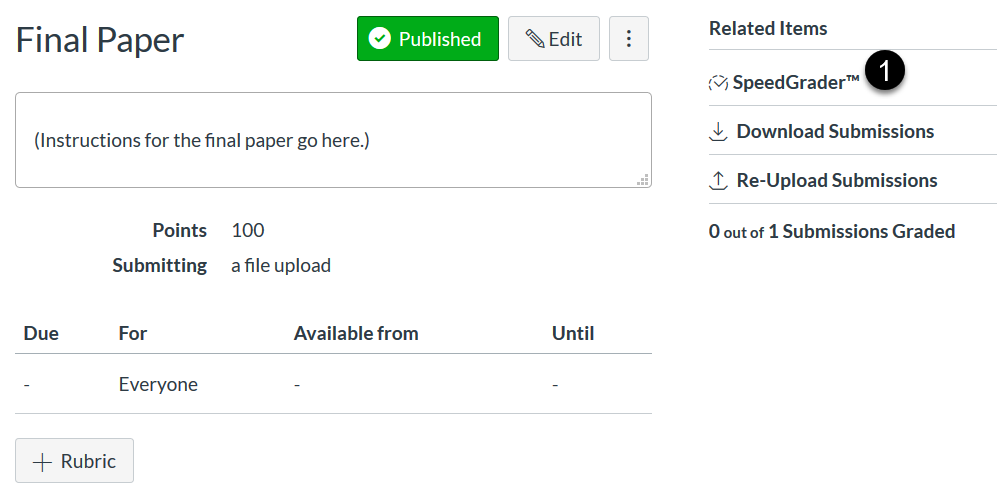
Within the assignment details window, click on SpeedGrader.
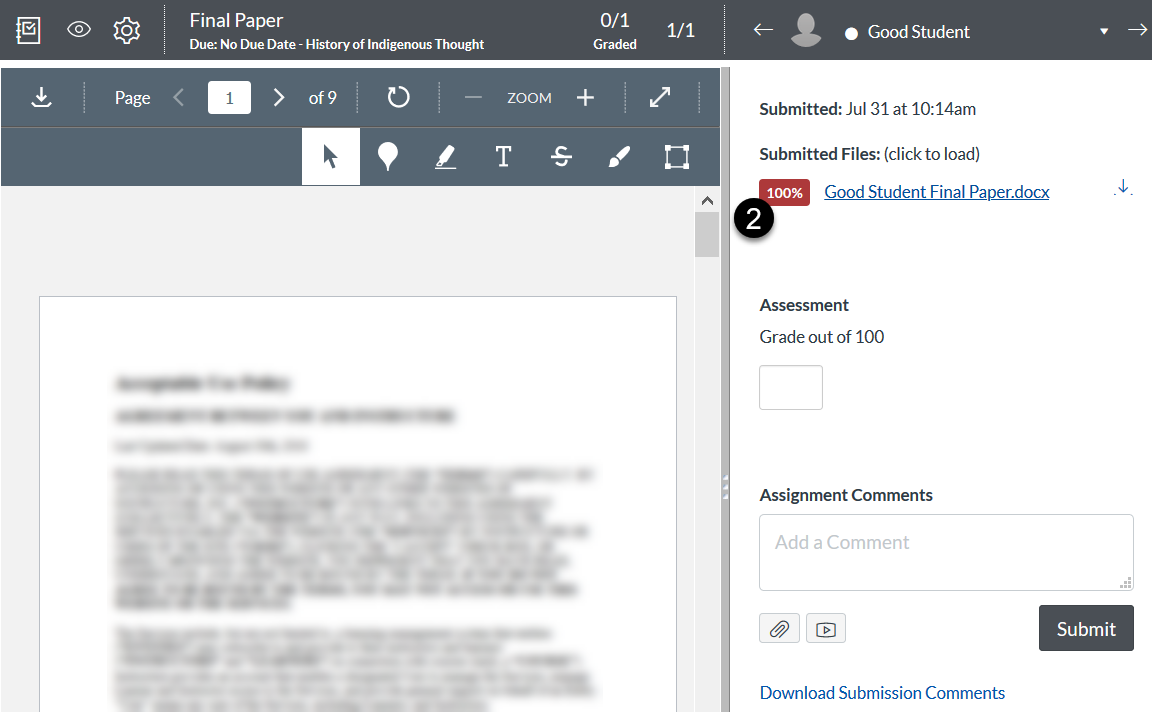
Once in SpeedGrader, click on the percentage highlighted in the red box. This will open the paper in Turnitin's similarity environment.
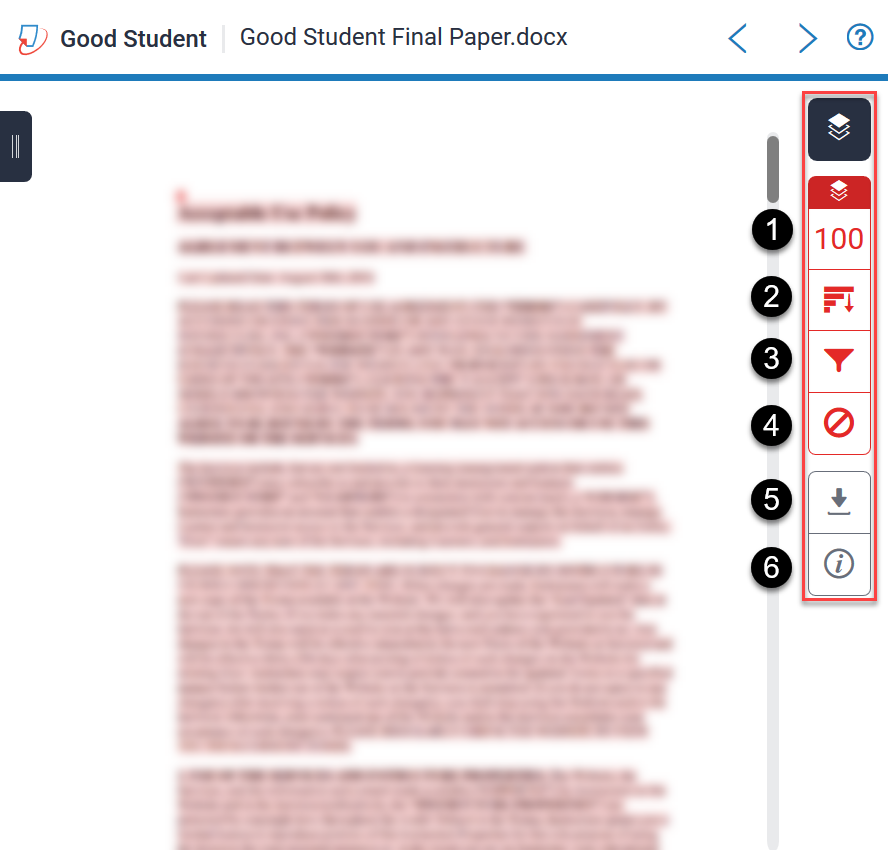
Full documentation on the Similarity Report
The Similarity Report has different features for you to use. In the column on the right-hand side, the first button [1] indicates what percent of the paper was found to be plagiarized.
In addition to tracking similarity in student submissions, Turnitin can be used to screen submissions for the presence of generative AI (e.g., ChatGPT).
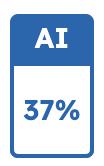
For submissions longer than 300 words, Turnitin will analyze the writing of the document and highlight areas that it believes to have been written by AI. It then displays a percentage 'score' that represents the amount of writing in the submission that was AI-generated. Click the percentage icon to open the report.
How to Use the Report
The report should be considered only a first screening and not proof, by itself, of misconduct. Misconduct depends on violations of explicit campus and course policies. Read the report's highlighted portions of the submission and decide for yourself whether they are evidence of misconduct.
Is it Accurate?
For many situations, yes. An academic study of various AI detectors published in 2023 placed Turnitin's algorithm at the top of dozens of detectors, with a perfect detection rate on the papers fed to it in the study. Read the study.
Caveats
Submissions below 750-800 words have a higher tendency to be mistakenly flagged as AI-generated when they are human writing.
The AI report cannot determine which tool was used to construct the flagged prose (ChatGPT, Grammarly, etc.).
Turnitin AI Detection FAQ
Stan State provides access to Turnitin's A.I. Detector tool for all instructors. Normally, the detector is used as part of a Canvas assignment that uses Turnitin in some way. However, it is possible to have a stand-alone file uploaded to Turnitin for analysis.
When submitted to Turnitin, a paper is given a 'score' that corresponds to the percentage of long-form prose (i.e., sentences contained within many multiple paragraphs) that the detector has high confidence was not human-produced. Longer submissions are more accurately scored, while shorter submissions may be more frequently incorrectly flagged. The A.I. detector does not reliably detect AI-generated text in the form of non-prose, such as poetry, scripts, or code. Nor does it detect short-form/unconventional writing such as bullet points (short, non-sentence structures) or annotated bibliographies.
Remember: Turnitin's A.I. score is a flag for further consideration, not an accusation of misconduct.
- How does it work?
- What parameters or flags does Turnitin’s model take into account when detecting AI writing?
- What does the percentage in the AI writing detection indicator mean?
- If students use Grammarly for grammar checks, does Turnitin detect it and flag it as AI?
- If students use Grammarly’s paraphrasing tool, will it flag their content as AI-generated?
- How should instructors interpret the results?
If you provide feedback using Turnitin's own GradeMark toolset (rather than Canvas's SpeedGrader), you will need to tell students how to access that feedback.
Students should:
- Login to the course and click the Grades link in the navigation menu.
- Locate the assignment in the list of assignments.
- Click the colored icon on the far right of the row to open the Turnitin interface.
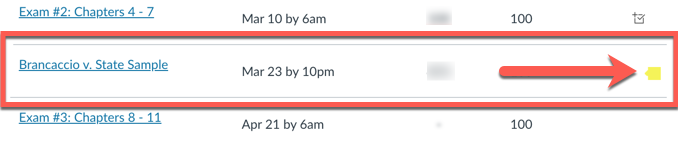
- Inside Turnitin, review the feedback and click any blue "Comment" icon to read the comment.
The Canvas integration with Turnitin does not permit an instructor to make an initial submission on behalf of a student and also have that submission be part of the Canvas assignment.
Resubmit on Student's Behalf
When using the new LTI 1.3 integration with Canvas, instructors can resubmit for a student who has already made an initial submission. This can be done from the Assignment Inbox.
- Open the Options menu for the specific student (the menu is on the far right of the page)
- Choose "Upload" from the menu
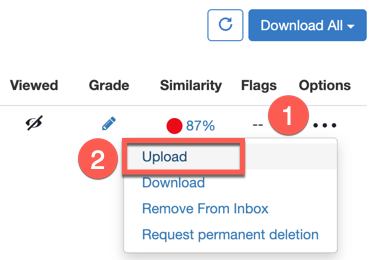
Then, locate the file you wish to upload. It will replace the previously submitted file in the Inbox.
Sometimes it's necessary to check a document for plagiarism or AI writing without having an assigned Canvas activity in a regular course. This can be done, but it still requires a Canvas assignment in order to upload the file.
Part 1: Create a sandbox assignment in a sandbox course
- Open a sandbox Canvas shell in your account. Note: instructors can create a sandbox shell by clicking "Start a new course" on their Dashboard.
- On the Assignments page, create an assignment called "Turnitin Check".
- In the settings, change the Submission Type to "Online" and enable the "File Uploads" choice.
- Scroll to the Plagiarism Review section and enable "Turnitin Plagiarism Framework" in the dropdown menu.
- No Due Date or Until date is necessary. Leaving these blank will allow you to reuse this activity for similar checks in the future.
- Click "Save and publish". The assignment must be published before the desired document can be uploaded.
Part 2: Use the Test Student to upload the document
- On the assignment page created in Part 1, click "View as Student" in the upper right corner of the page.
- Acting as the Test Student, click the "Start Assignment" button.
- Click in the file upload area to select and upload the document from your computer.
- Submit the assignment.
- After submitting, click "Leave student view" to return to your normal role.
Part 3: Review the similarity and AI reports
- Click "Speedgrader" in the upper right corner
- In Speedgrader, click the similarity percentage icon shown beneath the title of the document.
- Review the similarity report and AI writing reports in the new window that opens.
Note: This issue only occurs with assignments that are part of the advanced (LTI) integration with Canvas. Assignments using the "basic" integration are not affected.
If you have imported a Turnitin assignment from a prior Canvas course, in some cases the “date” fields for the Turnitin assignments still display the prior semester’s due dates/availability dates. If that occurs, you may receive the following error after attempting to input your current semester assignment due dates:
Sorry, we could not process your request. Turnitin assignment could not be created. date_post – post date must be after start date
Steps to resolve
To resolve this issue:
- Edit the Canvas assignment and remove any dates for Due date, Available, and Until. Click Save. You should see the Turnitin assignment Inbox appear below your assignment details.
- Click the Turnitin assignment settings gear icon to edit the Turnitin settings. Clear the date entry from the Start date; if applicable, you can also edit the date to your current Assignment start date. Also, change the due date to your current Assignment due date. Click Save/Submit.
- Edit the Canvas assignment again and modify the Assignment Date settings to include your current Assignment due date and if applicable, start/end dates. Save your assignment changes.
Updated: September 10, 2026