Science In Our Community
Science in Our Community is a cross-functional collaboration between the College of Science and the Office of Service Learning. Science in Our Community is a community-based Science, Technology, Engineering, and Mathematics (STEM) outreach group of programs where Stan State students have the opportunity to volunteer and teach K-12 students. Such programs include Science Day, Science Saturday, Junior Scientist, and Delhi Medical Academy. These programs are led by Stan State students in collaboration with university faculty who engage with K-12 students and community members in various STEM activities:
- To engage Stan State students through high impact practices that have been shown to increase retention in the STEM disciplines.
- To engage Stan State students to develop and showcase their STEM education background to the community.
- To allow Stan State students to teach the community about science and its importance in society.
- To encourage regional K-12 students to be engaged in STEM subjects and exposed them to higher education.
- To encourage regional K-12 students to attend Stan State and consider a STEM major, especially populations who are traditionally underserved and underrepresented in the STEM Community (i.e. students of color, first-generation, economically disadvantaged, and women).
- To encourage the community to visit the local campus and improve campus-community partnerships.
Appendix I
Data Collection for Academic Years: 2015-2016, 2016-2017, 2017-2018, 2018-2019, 2019-2020*
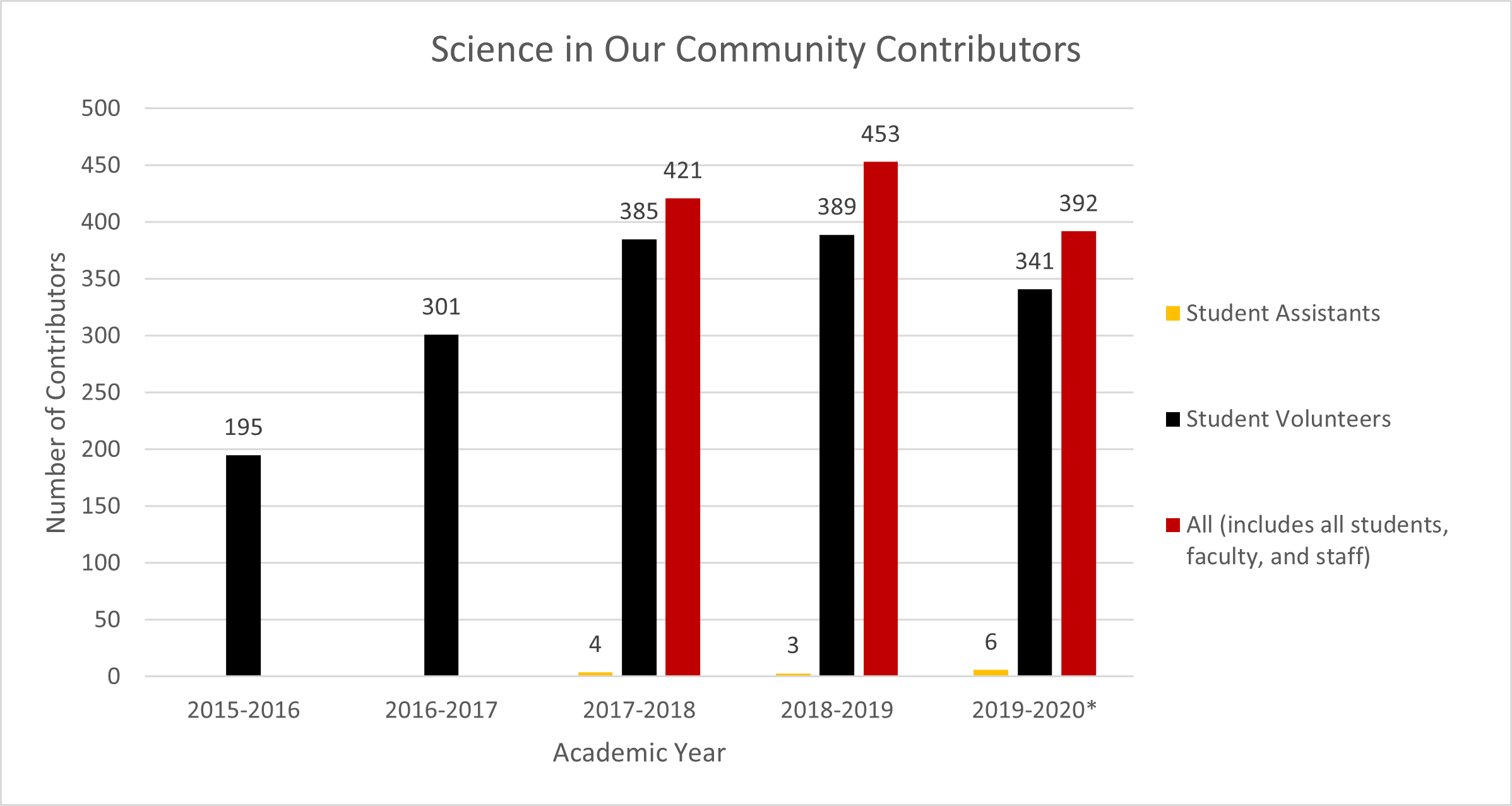
In 2015–2016, there were 195 student volunteers. In 2016–2017, there were 301 student volunteers. In 2017–2018, there were 4 student assistants, 385 student volunteers, and 421 total contributors. In 2018–2019, there were 3 student assistants, 389 student volunteers, and 453 total contributors. In 2019–2020, there were 6 student assistants, 341 student volunteers, and 392 total contributors.
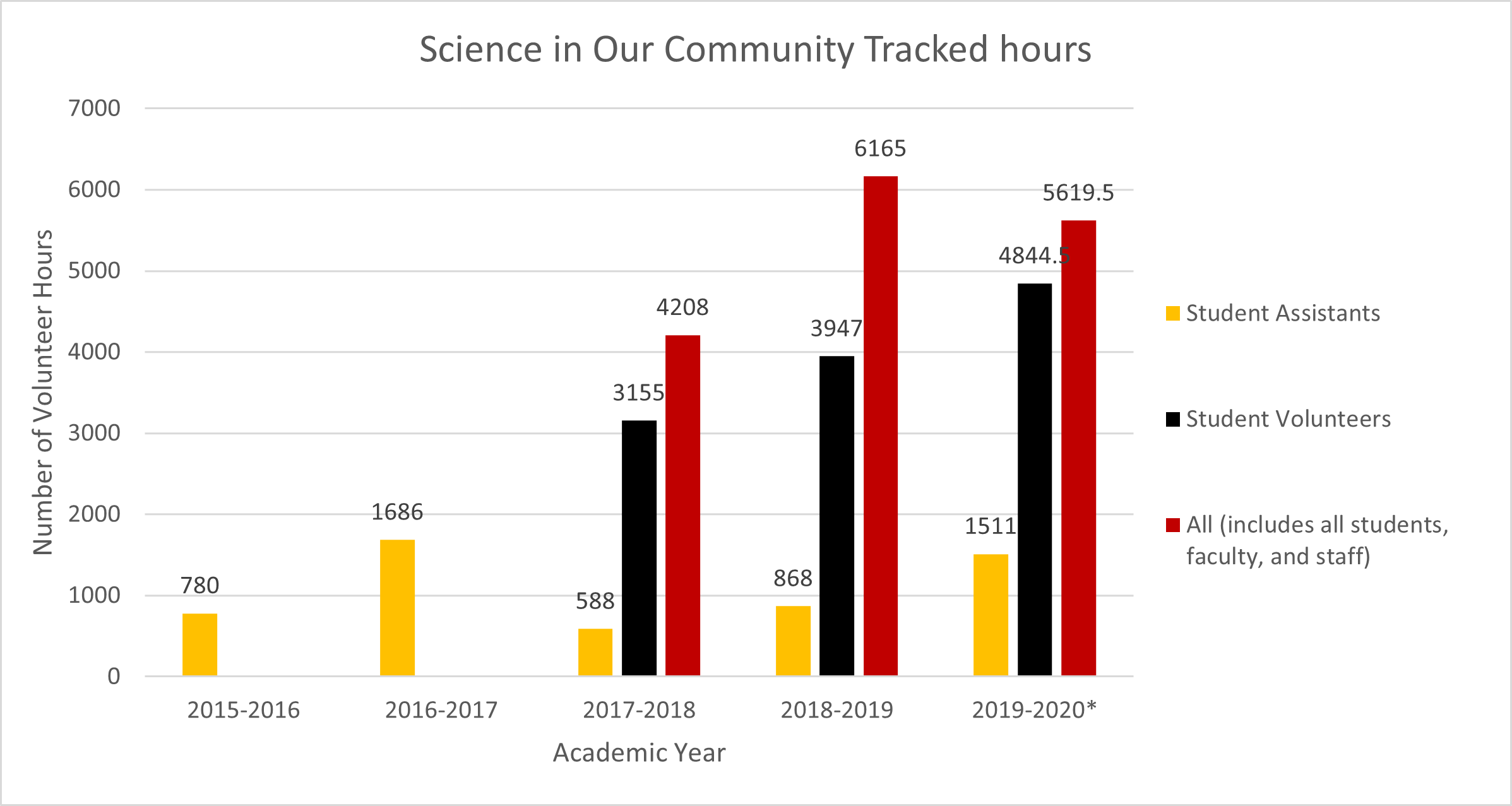
In 2015–2016, there were 780 student assistant hours. In 2016–2017, there were 1,686 student assistant hours. In 2017–2018, there were 588 student assistant hours, 3,155 student volunteer hours, and 4,208 total hours. In 2018–2019, there were 868 student assistant hours, 3,947 student volunteer hours, and 6,165 total hours. In 2019–2020, there were 1,511 student assistant hours, 4,844.5 student volunteer hours, and 5,619.5 total hours.
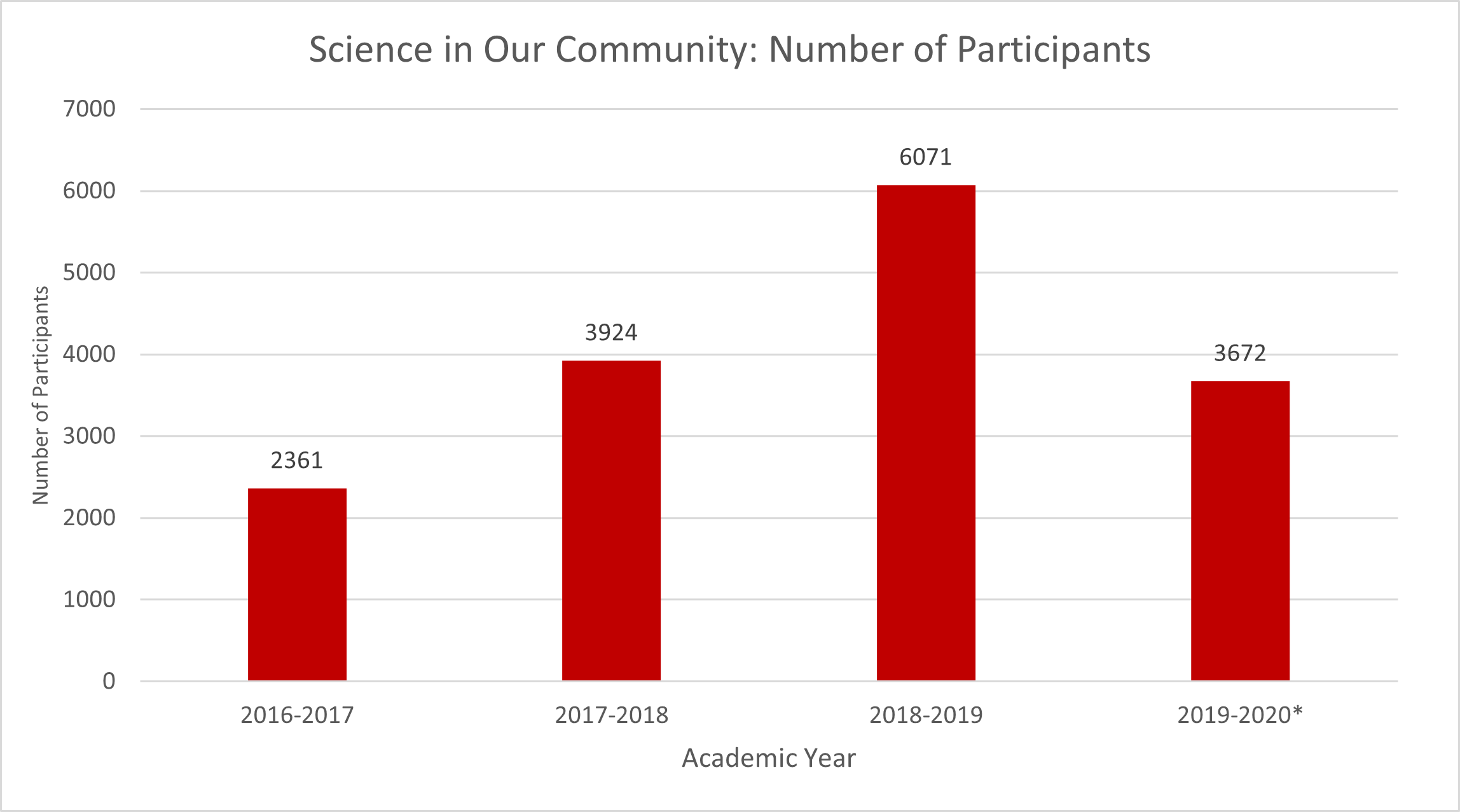
In 2016–2017, there were 2,361 participants. In 2017–2018, there were 3,924 participants. In 2018–2019, there were 6,071 participants. In 2019–2020, there were 3,672 participants.
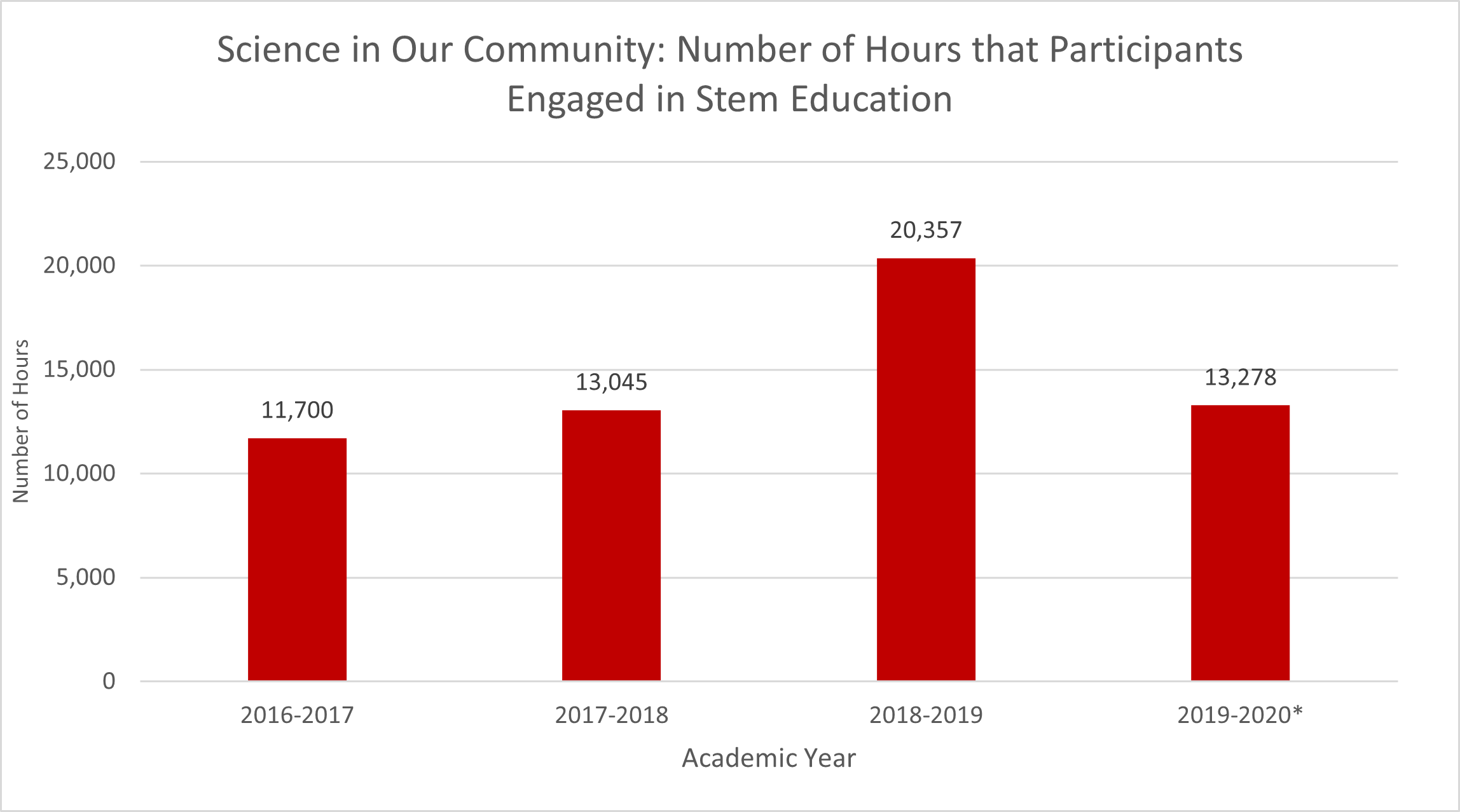
In 2016–2017, participants engaged in 11,700 hours of STEM education. In 2017–2018, participants engaged in 13,045 hours. In 2018–2019, participants engaged in 20,357 hours. In 2019–2020, participants engaged in 13,278 hours.
*Note: The data for 2019-2020 does not give the complete representation of the program, because due to COVID-19 most of the spring semester events were cancelled.
Appendix II: Titles of Lectures and Activities
- VIP College Day: Chemiluminescence
- VIP College: DNA Extraction from Strawberries
- VIP College Day: STEM Poster Presentations
- VIP Colle Day: Microscope Lab
- Yo Puedo: pH Lab
- Yo Puedo: STEM Careers
- Farmer’s Market: Ozobots
- Farmer’s Market: Cheek Cell DNA
- Farmer’s Market: Animal and Plant Cell
- Science Saturday: Geographical Informational Systems
- Junior Scientist: Pump it Up
- Science Saturday: Marvelous Metals
- Delhi Medical Conference: Blood Composition
- Delhi Medical Conference: Microorganisms and Plaque
- Delhi Medical Conference: Alchemist’s Gold
- Delhi Medical Conference: Explore the Magnetic Properties of Iron
- Delhi Medical Conference: EKG Lab
- Delhi Medical Conference: Anatomy Lab
- Delhi Medical Conference: Respiration and Acid Base Balance
- Delhi Medical Conference: Suturing Lab
- Special Event: Transit of Mercury
- Astronomy Night: Solar System Posters
- Astronomy Night: Astronomy Shorts
- Astronomy Night: Kid Zone
- Astronomy Night: Spectrology Lab
- Astronomy Night: Computational Lab
- Astronomy Night: Radiation Lab
- Astronomy Night: Debunking a Conspiracy
- Astronomy Night: crash Course in Optics
- Astronomy Night: Naraghi Telescopes
- Astronomy Night: Climate Change Presentation
- Astronomy Night: Game Room
- Astronomy Night: Out of this World
- Astronomy Night: Explore the Stars
- Science Saturday: Astronomy Night
- Junior Scientist: Candy Cane Lab
- Junior Scientist: Coding Lab
- Science Saturday: Save Our Home
- Science Day: Telepresence Robots
- Science Day: A/R
- Science Day: 3D Printing, and More
- Science Day: Science Shorts
- Science Day: Math- It is Not Just Bubbles
- Science Day: The Climate Change
- Science Day: Physics Demonstration
- Science Day: Solar Observing
- Science Day: Optics and Electricity
- Science Day: Women in Science
- Science Day: Rover, Rover, Send Chris Right Over
- Science Day: Coding with Ozobots
- Science Day: Emanuel Robots
- Science Day: Make and take your way to science fun!
- Science Day: Boiling and Unboiling Eggs Without Heat!
- Science Day: Robot Programming
- Science Day: Endangered Species
- Science Day: Life in Cold Blood-Dinos to Now
- Science Day: Food Parasites
- Science Day: Scientist Substance Making & Recyclable Building
- Science Day: How to Train Your Pigeon
- Science Day: Get Psyched: The Science of Psychology and Child Development
- Science Day: Skeletons
- Science Day: The Amazing Cell
- Science Day: Coloring Science
- Science Day: High Fidelity Simulation
- Science Day: CPR
- Science Day: Cow Hearts
- Science Day: Making Poop
- Science Day: Magnetic Field and Ferrous Metals
- Science Day: Is there Iron in your cereal?
- Science Day: Make a Compass
- Science Day: Tiny Creatures are Everywhere
- Science Day: Optics and Optical Illusions
- Science Day: 16th Century Alchemy Marvelous Metals
- Science Day: Tour Your Heart
- Science Day: Solar Telescope and North Observatory
- Science Plant you own seeds & Greenhouse Tours
- Science Day: Geocaching Native Plants
- Science Day: Turlock Irrigation District
- Science Day: National Ag Science Center
- Science Day: WOW 2 STEM Transfer Success Info Table
- Science Day: Know Your Vegetables
- Science Day: Heart
- Science Day: Enochs High School Forensic: Biotech Program
- Science Day: Learn more about Reptiles
- Science Day: Cell Baggie Model
Appendix III: Schools Where Participants Came From
- Agnes Baptist Elementary School
- Atwater High School
- Bernal Hughes Elementary School
- Brown Elementary School
- Buena Vista Middle School
- Central Valley High School
- Ceres High School
- Cesar Chavez Junior High School
- Connecting Waters Charter School
- Creekside Elementary School
- Crowell Elementary School
- Cunningham Elementary School
- Daniel J. Savage Middle School
- Delhi Medical Academy
- Delta Sierra Middle School
- Denair Elementary Charter Academy
- Dennis Earl Elementary School
- Dutcher Middle School
- Elizabeth Ustach Middle School
- Emile J. Ross Middle School
- Enochs High School
- Great Valley Academy
- Hazel Mahone College Prep
- Hensley Junior High School
- Hickman Charter School
- Hidahl Elementary School
- Hilmar Middle School
- Hughson Elementary School After School Program
- Julien Elementary School
- Lakewood Elementary School
- Livingston Middle School
- La Loma Jr Highschool
- Medeiros Elementary School
- Mitchell Senior
- Modesto Christian School
- Monache High School
- Modesto High School
- Monte VISTA Middle School
- Mountain view Middle School
- Northmead School
- Oakdale High School
- Osborn Two-way immersion Elementary School
- Patricia Kay Beaver Elementary School
- Pitman High School
- Prescott Junior High
- Salida Middle School
- San Benancio Middle
- Signs of Agape Academy
- Sisk Elementary School
- Somerset Elementary School
- Sonoma Elementary School
- Sonora Elementary School
- Sunnyside High School
- Summerville High School
- Thomas Downey High School
- Tracy Area Homeschool Academy
- Tracy-Monte Vista Middle School
- TRIO Renner Elementary
- Turlock High School
- Turlock Junior High School
- Valley Home School
- Van Renner Elementary
- Vanguard Prep Academy
- Wakefield Elementary School
- Walnut Elementary School
- Washington Middle School
- Whitmore Charter High School
Appendix IV: Data of Services received by University Students
Stan State STEM students received multiple services from the CSU STEM VISTA coordinators. This included working one-on-one with students volunteering in the program. During this time, the program establishes an initial rapport with each student utilizing Yosso’s Cultural Wealth Model to identify the strengths the student brings to the program. Then continue to establish rapport with the STEM Ambassadors through regular check-ins to discuss the campus student services and the opportunities the program offers. When a STEM Ambassador showed interest in presenting a STEM lesson, They were provided tools and information to create a lesson plan, gather the materials needed for the activity, and train the volunteers supporting the lesson.
Along with that during the New Student Orientations for freshmen, transfer and Stockton Campus the program provided the students with Campus Resources List to each student visiting their table. They also provided information about Science in Our Community, community engagement opportunities at Stan State, internships, student engagement online tools and students clubs and organizations.
The program presented two workshops at the STEM Discovery Academy providing the students with information on the importance of utilizing resources such as the Tutoring Center, the Writing Center, and Advising to maintain good grades. They also learned about the importance of campus and community engagement and its benefits for graduate school and their career.
Through the program coordinated workshops with the help of a STEM Ambassador and campus partners, such as the Career and Development Center and Psychological Counseling Center. The campus partners and the STEM Ambassador presented the following workshops: Achieving Student Success, Why Science Students Need Community Engagement, Resume Building for Science Students.
In total 455 students were impacted by these services with a total of 475 hours of services being received.
Appendix V: Names of all the Faculty Involved
- Dr. Elvin Alemán
- Dr. Ritin Bhaduri
- Dr. Claudia Brackett
- Dr. Jose Díaz-Garayúa
- Dr. Jessica De Silva
- Dr. Clay Everett
- Dr. Michael Fleming
- Dr. Andrew Gardner
- Dr. Mark Grobner
- Ms. Shannon Hernandez
- Ms. Janice Herring
- Dr. Bjorg Johannsdottir
- Dr. Terry Jones
- Dr. Brian Jue
- Dr. Choong-Min Kang
- Dr. Patrick Kelly
- Dr. Kyu Han Koh
- Dr. Amanpreet Manchanda
- Dr. David Martin
- Ms. Wendy Matthew
- Mr. Philip Magner
- Dr. Alison McNally
- Dr. Susan Mokhtari
- Dr. Brian Morsony
- Dr. Oluwarotimi Odeh
- Dr. Grace Paradis
- Dr. Shane Phillips
- Dr. Scott Russell
- Dr. Julia Sankey
- Dr. Jeffrey Scales
- Dr. Gönül Schara
- Dr. Koni Stone
- Dr. My Lo Thao
- Dr. Dianne Vargas
- Dr. Gary Williams
- Dr. Katie Wiskow
- Dr. Janey Youngblom
- Dr. Jim Youngblom
- Dr. Liangmin Zhang
Appendix VI: Names of all the Staff Involved
- Tawn Anderson
- CJ Chaney
- Matt Collins
- Brenda Dang
- Michaela Dole
- Monica Doll
- Brett Forray
- Julie Fox
- Michele Gordon
- Kellie Gregorio
- Breanna Hale
- Daisy Hernandez
- Hugo Hernandez
- Kathleen Hidalgo
- Martin Hildebrandt
- Sunpreet Kaur
- Francisco Marmolejo
- Kellie Marshall
- Miriam Moreno
- Heather Jaeger
- Rocio Luna
- Megan Parravano
- Ashley Scoles
- Luis Segovia
- Cheri Silveira
- Malinda Simao
- Carrie Sonke
- Kristina Stamper
- Veronica Taylor
- Marilu Velasco
- Rhonda Willson
- Lt. Givo Ysael
- Dylan Zaharris
Appendix VII: Projected numbers with cancelled events
Due to COVID-19 the data for 2019-2020 does not give the complete representation of the program, because most of the spring semester events were cancelled as a result of it. Thus, we cancelled the following events:
- Delhi Medical Academy Lab
- Science Saturday
- Brown Elementary School Visit
- Junior Scientist
- Earth & Science Day
- Cunningham Elementary School-Science Night
- Solar Electricity Summer Camp
- Summer Camp
These events that were cancelled due to COVID-19 would have included a projected number of 2,360 participants and recieved 9,060 hours of service.
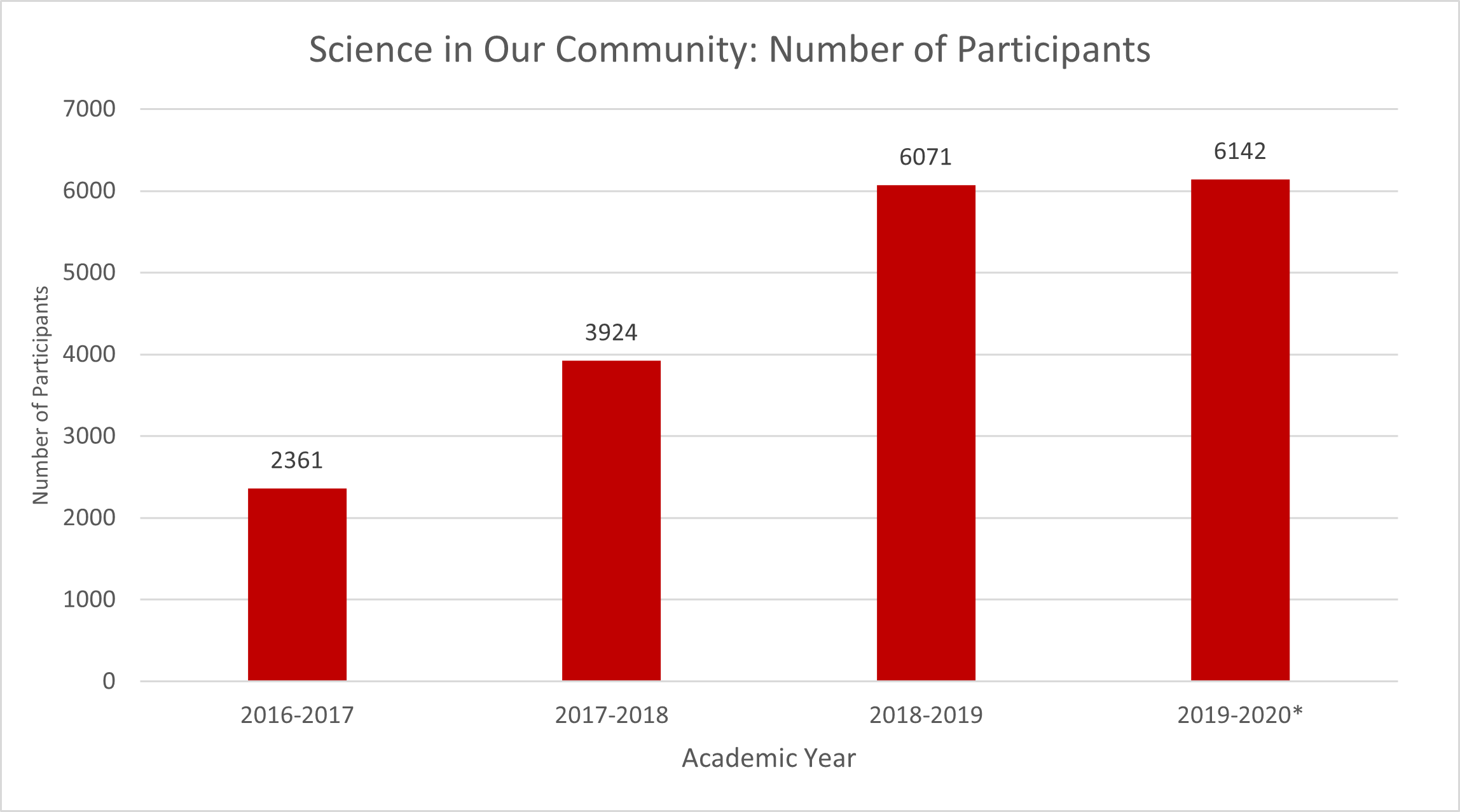
In 2016–2017, there were 2,361 participants. In 2017–2018, there were 3,924 participants. In 2018–2019, there were 6,071 participants. In 2019–2020, there were 6,142 participants.
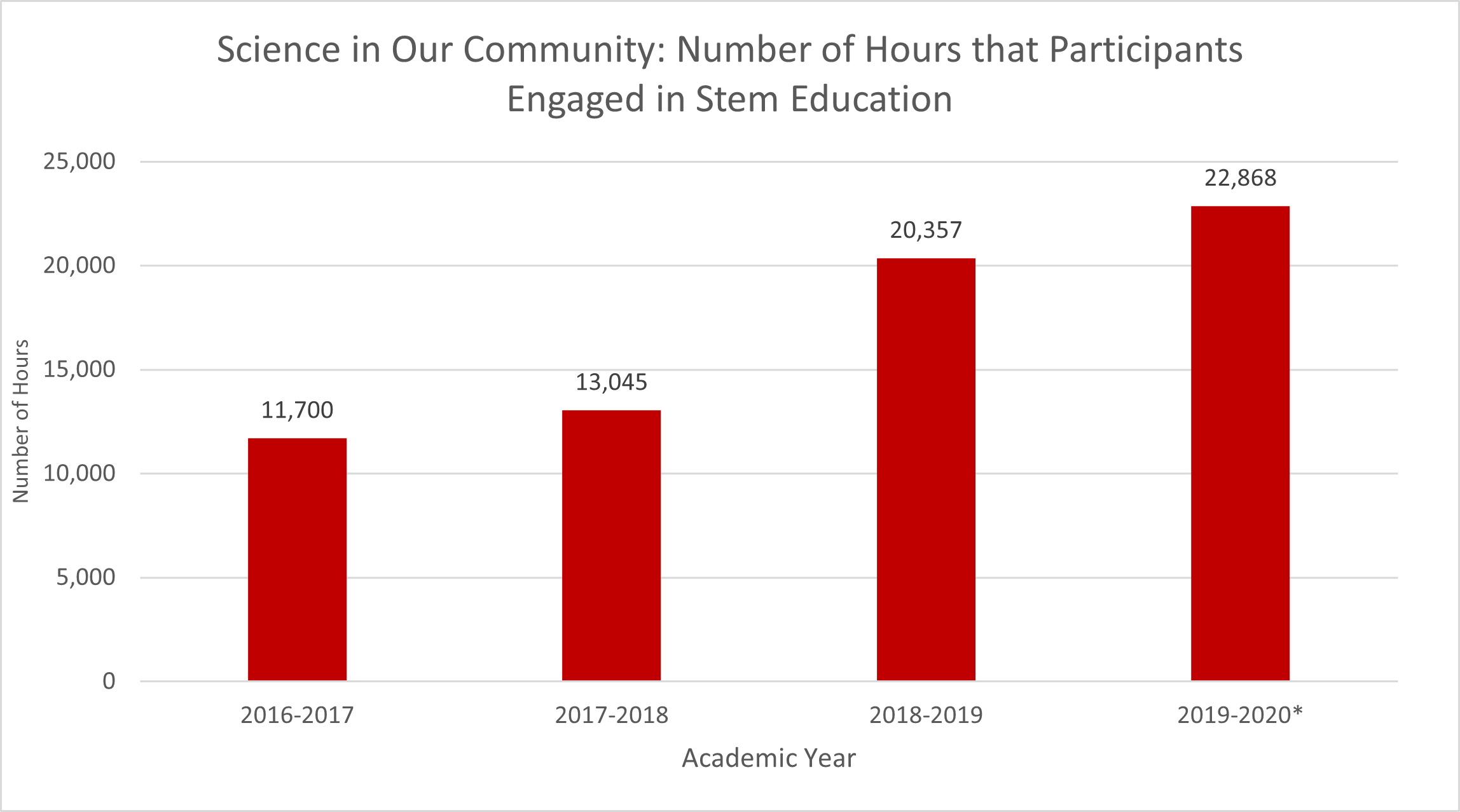
In 2016–2017, participants engaged in 11,700 hours of STEM education. In 2017–2018, participants engaged in 13,045 hours. In 2018–2019, participants engaged in 20,357 hours. In 2019–2020, participants engaged in 22,868 hours.
Updated: March 20, 2026