After discussing shifts in global power and their implications for the United States, Mexico and China, Rafael Fernández de Castro turned his attention to the Stanislaus State students sitting before him.
He gave them five recommendations for navigating a changing world: engage globally, become active citizens and build networks, strengthen their bicultural identities, respect people with whom they disagree and focus on excelling as students.
“Don’t close yourself to the world,” Fernández de Castro said. “You’re already citizens of the world and continue to be.”
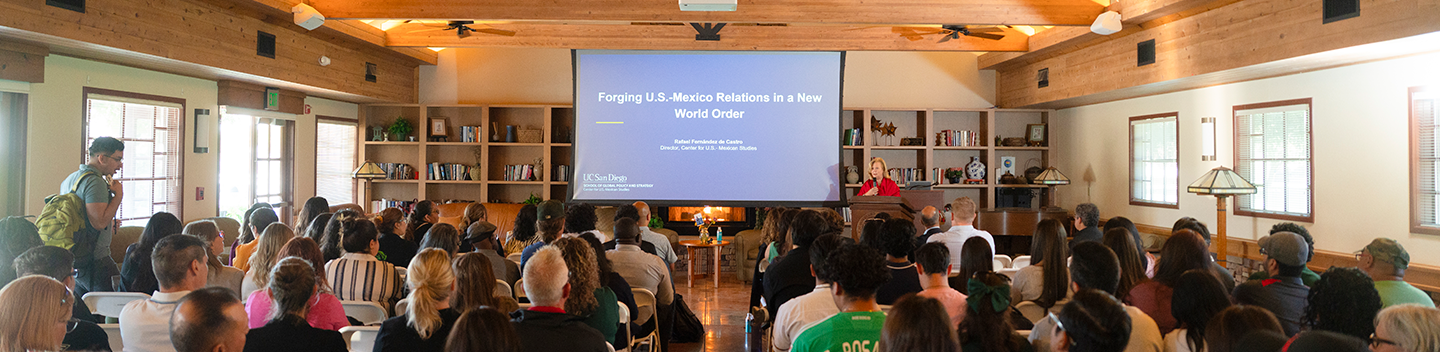
Fernández de Castro, professor and director of the Center for United States-Mexican Studies at UC San Diego’s School of Global Policy and Strategy, delivered his message Monday, Sept. 28, as part of Stan State’s Presidential Distinguished Speaker Series. A former foreign policy adviser to Mexican President Felipe Calderón, Fernández de Castro is an expert in U.S.-Mexico relations and geopolitics and has authored more than 100 books and academic articles.
The lecture, titled “Forging U.S.-Mexico Relations in a Dynamic New World Order” drew students, faculty, staff, administrators, alumni and community members to the John Stuart Rogers Faculty Development Center and was followed by a fireside chat moderated by Professor of Advanced Studies Virginia Montero Hernández, director of the Stan State’s doctoral program in educational leadership.
The discussion came at what Fernández de Castro described as a consequential moment for U.S.-Mexico relations and the broader geopolitical landscape.
President Britt Rios-Ellis opened the program by describing the speaker series as a way to connect ideas, elevate voices, and strengthen critical thinking within the University and broader Central Valley community.
“This is such an important space for all of us to learn about U.S.-Mexico affairs,” Rios-Ellis said. “We share a deep history of relationships that span families, solutions to climate change, healthcare and so much more.”
She also pointed to Stan State’s growing efforts to give students accessible, short-term opportunities to study in Mexico, saying the University hopes more than 100 Warriors will study there this year.
Rios-Ellis emphasized the depth of the ties between Mexico, California and the Central Valley, including cultural connections, student experiences and economic relationships.
“I have seen what Study Abroad can do for folks, and I want to make sure that our students have that opportunity,” she said. “We know that if a student studies abroad, they are more likely to complete their education. We have to understand that Mexico is not just our neighboring country. It’s actually our roommate in the Americas.”
A Shifting Global Order
Fernández de Castro placed U.S.-Mexico relations within a broader examination of shifting global power, exploring the United States’ changing role in the world and the forces reshaping relations among nations. He described what he sees as a shift in U.S. global leadership alongside China’s economic, technological and military influence.
He told audience members that understanding China will be increasingly important as the two countries compete in areas including artificial intelligence, energy, advanced computing and international alliances.
Fernández de Castro also focused on migration and border policy, trade and the upcoming review of the United States-Mexico-Canada Agreement, which he described as crucial to Mexico’s economy.
For students, he said those global developments make curiosity, engagement and relationship-building increasingly important. He encouraged them to learn about other countries, travel when possible and use technology to develop relationships beyond their own communities.
He pointed to a Stan State communications student who introduced himself during Fernández de Castro’s visit and asked for his phone number. Fernández de Castro told the audience he would be happy to serve as a resource and potential mentor to the student.
“You’ve got to do that,” Fernández de Castro said. “To come to this beautiful campus is not only about being a very good student, but also about creating networks. Go and introduce yourself. You have to try now, not later.”
He also encouraged students to take pride in their cultural and linguistic identities and deepen their understanding of the countries and cultures that have shaped them.
During the fireside chat with Montero Hernández, she asked Fernández de Castro how individuals can become constructive agents of change when geopolitical issues can seem distant from everyday life. He urged students to stay informed about world affairs and develop the knowledge needed to evaluate the information they encounter.
That responsibility extends to how students engage with people whose beliefs differ from their own, Fernández de Castro said. He encouraged students to speak their minds while listening respectfully and making an effort to understand opposing viewpoints.
“You should speak your mind, and you should be able to talk to the others,” Fernández de Castro said. “Just be very respectful of the beliefs of others. This is key for your life.”
When asked about the role of higher education, Fernández de Castro called education “the premier tool for improving lives and societies.”
That message echoed a point he had made earlier to students.
“My advice is for you to do well here,” Fernández de Castro said. “You have to try very hard, because this is a great opportunity for you to become whatever you want to be in your life.”