A new weekly radio program on KCSS 91.9 is using music as a gateway to cultural storytelling, geography and community connection at Stanislaus State.
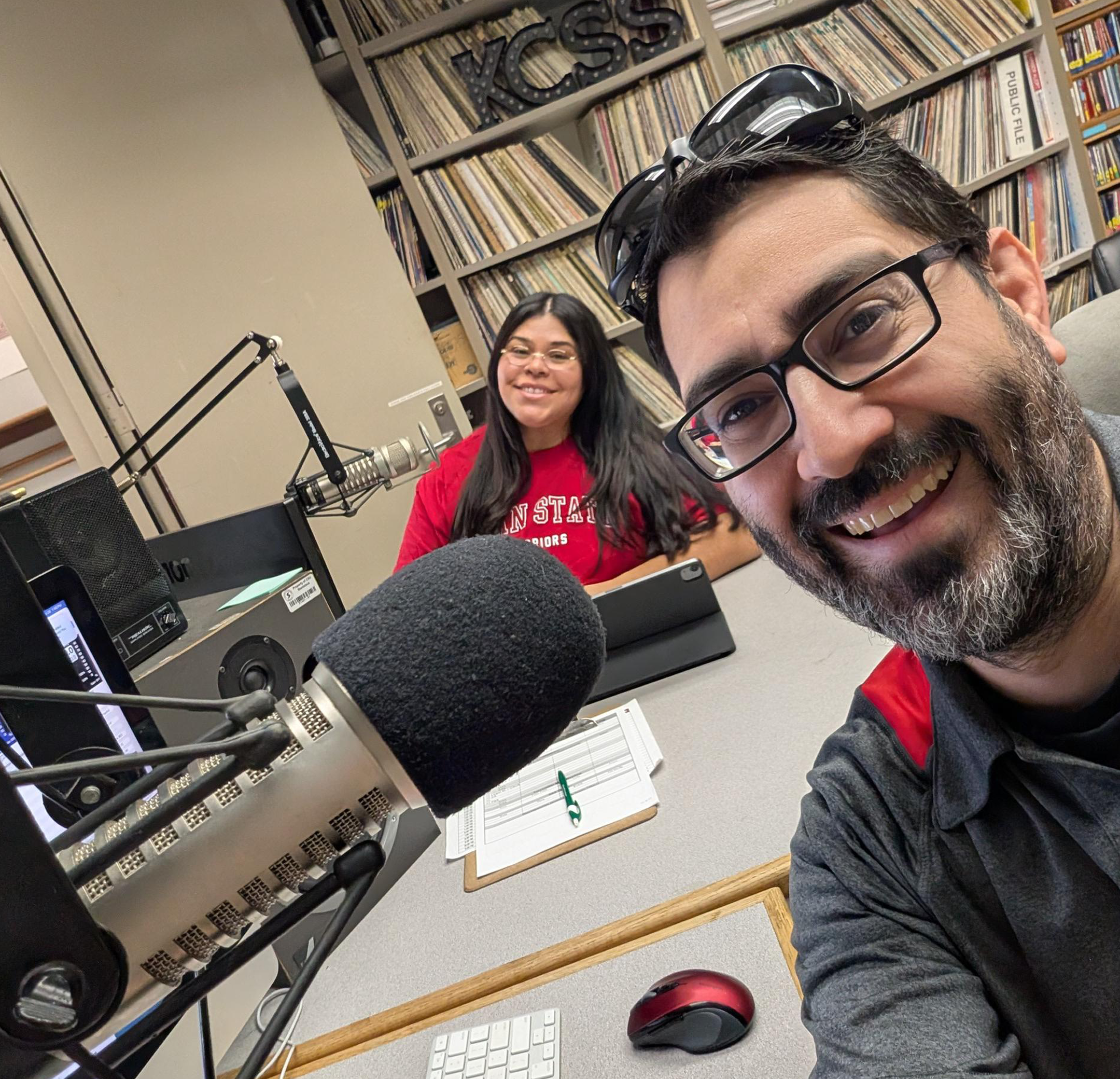
“Música, Cultura y Geografía,” airs Wednesdays from 2 to 4 p.m., hosted by José R. Díaz-Garayúa, Ph.D., professor of geography, in collaboration with Stanislaus State student Yanet Soto Pallares, who also inspired the name for the program. Broadcast primarily in Spanish with bilingual commentary, the show blends music with historical, cultural and geographic context.
For Díaz-Garayúa, the program reflects a long-standing commitment to ensuring the University’s cultural life and public spaces mirror the experiences and voices of the students and communities it serves.
“When I came for my campus interview in 2016, I noticed that although more than half of our students identify as Hispanic, that presence was not always visible in campus imagery or cultural expression,” Díaz-Garayúa said. “I later learned that KCSS had Spanish-language programming in the past, and the idea of giving continuity to that kind of programming has always stayed with me.”
He noted that the University has made meaningful progress over the years, pointing to the creation of the Warrior Cross Cultural Center, bilingual commencement programming and new murals across campus. The radio show, he said, is another way to move that work forward.
The program also reflects the educational mission of KCSS as a hands-on, student-centered learning environment where students are deeply involved in every aspect of production. During the show’s development, Díaz-Garayúa worked closely with KCSS student leaders Adin Dibble, station manager; Luis Mincey, production engineer; and Yanet Soto Pallares, work-study assistant.
“KCSS is an educational platform with students always at the forefront,” he said. “It provides non-commercial cultural programming, serves the University and surrounding communities, and functions as a laboratory where students learn how a non-commercial radio station operates.”
Before launching the show, Díaz-Garayúa immersed himself in the station’s operations, working closely with KCSS leaders and student staff and producing a pilot episode that aired last semester. He also extended gratitude to Greg Jacquay, general manager at KCSS and faculty member in the Department of Communication Studies.
“All of them have offered excellent support,” Díaz-Garayúa said. “This is the main reason this has been possible.”
For Soto Pallares, the show is rooted in personal experience and a desire to create space for multilingual and multicultural expression.
“I am a first-generation Mexican American, and I heavily rely on ‘Spanglish,’” Soto Pallares said. “I can have a full conversation in either Spanish or English, but I don’t fully feel myself. I have the best conversations when I am able to speak both languages.”
She said discovering bilingual and bicultural artists such as LUNA LUNA, Maye, Cuco and The Marías affirmed that blended identities and languages can coexist naturally in music.
“What I hope to accomplish with ‘Música, Cultura y Geografía’ is to share the different sounds of music that are created by many talented Latinx artists,” Soto Pallares said. “A lot of their music speaks to similar hurdles or heartbreak that we experience in life. Music has always been a way of finding common ground to understand yourself and, most importantly, one another.”
Geography is a central thread throughout each broadcast, shaping both the music selection and the conversations that accompany it. Soto Pallares said the concept emerged organically through her collaboration with Díaz-Garayúa.
“Originally, I wanted to start an all-Latin Spanish radio show,” she said. “But there are so many artists from different countries and backgrounds who have created masterpieces over the years. Geography became part of the conversation because Professor Díaz- Garayúa is a geography professor, and we both had a vision to share music and sounds from around the world.”
Díaz-Garayúa connects music to place, history and social experience through the lens of cultural geography, drawing parallels between how cultural movements emerge across regions and how music carries those stories forward.
“It is hard to think about a cultural group without music,” he said. “Songs tell stories about people, place and social conditions. In that sense, music is deeply tied to geography.”
He pointed to the Afro-Puerto Rican musical tradition of Plena as one example, describing it as a genre rooted in percussion that historically functioned as a “sung newspaper,” documenting social and political life.
KCSS 91.9 is the student-run, non-commercial educational radio station at Stanislaus State and has served the campus and region since 1974.