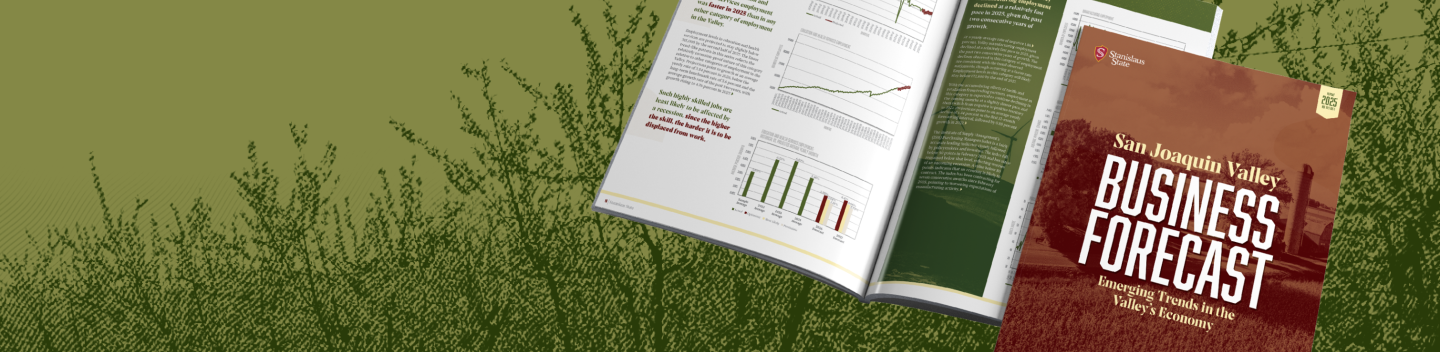
California’s Central Valley faces rising recession risks as tariffs, slowing employment growth and heightened financial stress continue to weigh on business and consumer confidence, according to the Fall 2025 San Joaquin Valley Business Forecast produced by Gökçe Soydemir, the Foster Farms endowed professor of business economics at Stanislaus State.
The Fall 2025 Forecast finds that the region’s long-anticipated slowdown is now fully materializing. The Federal Reserve has announced a series of rate cuts beginning in late 2025, but their economic impact will lag as existing contracts expire, and new agreements reflect lower borrowing costs. The earliest signs of improvement are not expected until the second half of 2026.
Meanwhile, the effects of ongoing protectionist trade policies are becoming more pronounced. Tariffs and retaliatory measures have reduced trade volumes, driven up costs and created widespread uncertainty that is restraining investment and contracting real GDP growth.
To navigate this uncertainty, the report notes that Valley residents may consider strategies such as:
- Maintaining cash reserves
- Continuing to rent rather than buy until interest rates align with long-term benchmarks
- Purchasing a home now only if refinancing later is feasible
- Taking advantage of falling bond yields
- Using flexible-rate financing and low-cost student loans to upgrade skills if laid off
These recommendations, along with detailed projections through 2027, are outlined in the Fall 2025 San Joaquin Valley Business Forecast.
Highlights from the Forecast
Employment Indicators
Employment growth slowed across most sectors in 2025 and is expected to weaken further into the first half of 2026. Retail trade, information, financial activities, construction and leisure and hospitality services all posted declines. Manufacturing also contracted following two years of growth.
Education and health services remained the strongest-performing category and are among the least vulnerable to recession, although growth in this sector also decelerated. Government employment grew for the third consecutive year but is expected to decline with its typical lagged response to business cycles.
The regional unemployment rate, currently just under 8 percent, is projected to climb above 10 percent in the coming months. Overall recession risk now stands at 50 percent, significantly higher than the long-term average of 15 percent.
Housing Sector
Housing activity slowed as building permits declined in 2025 following a strong 2024. Inventory shortages continued to push home values upward despite high interest rates. Real home value appreciation in 2025 was smaller after adjusting for inflation.
Projections suggest home values will rise more slowly than the long-term benchmark rate through 2026, with a faster pace of growth expected in 2027 once rate cuts fully filter through the economy.
Inflation, Prices and Wages
Inflation trended downward but did not reach the Federal Reserve’s 2 percent target due to persistent cost-push pressures from tariffs. Oil prices remain a major driver of inflation, though they are expected to fall further with a slowing global economy.
Average weekly wages rose in 2025 at a pace above inflation, leading to a gain in purchasing power following two years of decline. Wage growth is expected to flatten in 2026 and 2027.
Banking and Capital Markets
Valley community bank nonaccrual assets rose sharply in 2025, signaling heightened financial strain. Delinquencies are expected to rise further in 2026 alongside higher unemployment and a cooling economy.
Total deposits and net loans and leases increased in 2025, though deposit growth slowed. Community banks are likely to experience below-par performance in the near term before stabilizing, as interest rate cuts take full effect.
About the Report and the Author
Gökçe Soydemir’s biannual San Joaquin Valley Business Forecast provides projections for labor markets, regional housing, inflation and prices, banks and other depository institutions and capital markets. The forecast uses a unique econometric model that produces upper and lower statistical confidence bands, with actual outcomes expected to fall within this range.
Soydemir joined Stanislaus State in 2011 as the Foster Farms endowed professor of business economics. He brings extensive expertise in regional economics, applied econometrics, financial forecasting and market analysis.