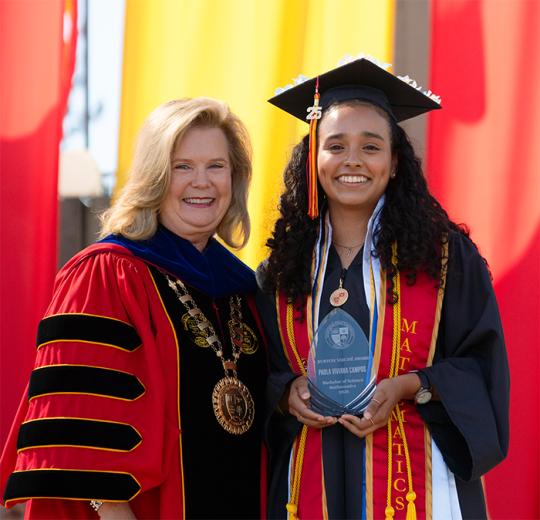
Paola Campos came to the United States from Mexico as a child. She was in first grade and learning English when her father passed away. Feeling she didn’t have many people she could relate to, Campos said she dug herself into her education. At Central Valley High School in Ceres, she passed 12 Advanced Placement exams.
“For the longest time, college wasn’t a question of if, but where I would go, and how I would get there,” Campos said.
Campos graduated from Stanislaus State in 2025 with a Bachelor of Science in Mathematics and is now earning a doctorate in applied mathematics at UC Davis.
Her path — from wondering how she would afford college to pursuing her doctorate — shows why measures of access, affordability and student outcomes matter.
Those measures are at the center of Washington Monthly’s 2026 Best Colleges for Your Tuition (and Tax) Dollars rankings. Stan State ranks No. 45 among 1,504 colleges and universities nationwide, No. 13 in the West and No. 37 on the publication’s list of America’s Best Hispanic-Serving Colleges.
The University also lands at No. 4 for affordability and No. 24 for outcomes in Washington Monthly’s West ranking. Among CSUs included in that ranking, Cal Poly Maritime Academy and Stan State earned the highest and second-highest outcomes rankings, respectively.
Washington Monthly evaluates institutions across four equally weighted areas: access, affordability, outcomes and community/national service. Its outcomes measure looks at how students perform through graduation and after college, including graduation performance, gaps between Pell and non-Pell students, earnings and the number of graduates who go on to earn doctoral degrees.
Washington Monthly lists Stan State’s average net price at $4,613 for first-time, full-time, in-state students from families earning less than $75,000. The publication reports median student loan debt of $13,540 among graduates and an eight-year graduation rate of 70 percent.
The Washington Monthly results are among several recent national measures of Stan State’s value and outcomes. In TIME and Statista’s inaugural America’s Best Colleges of 2026-2027, Stan State ranks No. 188 of 500 institutions. TIME places significantly more weight on student outcomes, which account for 75 percent of its overall score, while Washington Monthly weighs access, affordability, outcomes and service equally.
In August, The Princeton Review included Stan State in its 2027 Best 392 Colleges for the 21st consecutive year. Stan State and San Diego State were the only CSU campuses included on the list.
Earlier this year, Money.com awarded the University five stars for the third consecutive year in its 2026-27 Best Colleges list. Stan State was among 42 institutions nationwide — and 17 public four-year institutions — to receive Money’s highest rating, which evaluates colleges on measures including affordability, student debt, graduation rates and earnings.