Why Trust Cannot Be Confined to a Grant Cycle
Collins’ research examines what happens when state agencies and organizations attempt to build partnerships with tribes through short-term projects.
Many grants last two or three years. Collins explains why those timelines do not align with the time required to establish trust.
“Tribes don’t work on those timeframes. They can’t put a deadline on trust,” Collins said.
She also describes the phrase “come right,” which she heard repeatedly during her research. The phrase asks people to examine their intentions before entering a relationship with a tribe.
Collins said tribes have often been asked to contribute knowledge to projects after goals, deliverables and methods already have been established. Meaningful collaboration requires tribal participation earlier in the process, including during project design.
She encourages agencies and researchers to ask different questions. Who designed the process? Who controls the decision-making structure? What needs to change before tribes are invited to participate?
Who Built the Table?
Collins challenges the common question, “How do we bring tribes to the table?”
She suggests a more important question.
"I think the more important question to start asking is who built the table? Who runs the table?"
\Her research shows how policies and procedures often require tribes to adapt to systems built without tribal participation. Changing those systems requires more than inviting tribes into an existing process.
Agencies and researchers also need to reconsider when tribes are contacted, how project goals are defined and whose knowledge shapes the work.
Moving Beyond Consultation
Consultation remains an important process for protecting Native sites and cultural resources. Collins explains why consultation alone does not create a relationship or establish co-management.
California Assembly Bill 52 requires agencies and organizations to consult with tribes when projects could disrupt land in California. Collins found that, for some professionals, the consultation process was their only experience working with tribes.
“Consultation processes are important. They matter,” Collins said. “That is not the same as collaboration or co-management or building a relationship.”
Collins describes consultation as one part of a larger process. Meaningful collaboration requires sustained relationships, shared decision-making and support for tribal priorities.
Keystone Stewards Bridge Communities and Institutions
Collins developed the term “keystone stewards” to describe people who help bridge relationships between tribes, agencies, researchers and other organizations.
These individuals often connect people across institutional and cultural boundaries. They help translate expectations, build relationships and identify opportunities for cooperation.
Collins said keystone stewards show the value of individual relationships. Their work also reveals a weakness in systems that depend on a small number of people to carry the responsibility for collaboration.
Long-term progress requires institutions to support these bridge-builders while also changing the structures around them.
Research Through Interviews, Fieldwork and GIS Mapping
Collins used an interdisciplinary approach combining anthropology and geography.
Her research included ethnographic interviews with agency staff and researchers, along with 137 hours of participant observation at workshops, stewardship meetings and conferences where tribal collaboration was discussed.
She also used GIS mapping to examine how land ownership and agency authority affect tribal access to specific locations.
Collins placed land holdings into ArcGIS Pro and analyzed the number of agencies and organizations a tribe might need to contact within a single one-kilometer-by-one-kilometer area. Her analysis found an average of 19 different agencies or organizations.
The finding illustrates the logistical challenges tribes face when seeking access to ancestral sites, cultural resources or locations for ceremony.
Why Land Access Matters
Collins argues that tribal participation in environmental management requires more than an invitation to share knowledge.
Tribes also need opportunities to reconnect with ancestral lands.
“You have to let them connect with the land again,” Collins said. “You have to let them spend time out there and re-establish those relationships.”
Temporary entry permits and liability requirements often make access difficult. Collins explains how these restrictions limit opportunities for tribes to spend time on land connected to their history, culture and family stories.
She also describes the difference between viewing land as a resource and viewing land as a relative or ancestor.
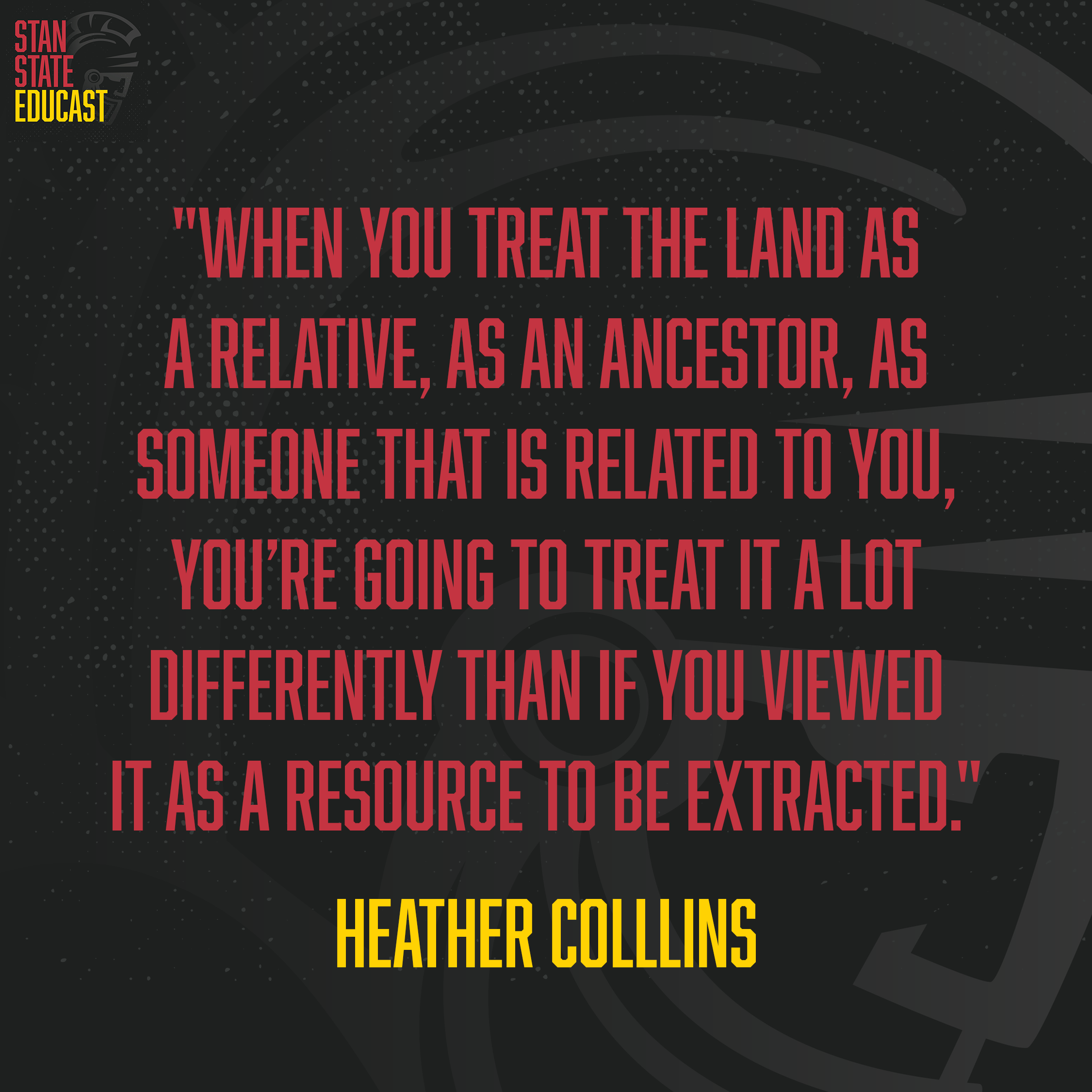
"When you treat the land as a relative, as an ancestor, as somebody that is related to you, you're going to treat it a lot differently than if you viewed it as a resource to be extracted."
Traditional Fire and Environmental Stewardship
The episode also explores the role of traditional fire in California’s ecosystems.
Collins discusses a Department of Water Resources pilot cultural burn in the Delta, one of the first such burns in the area in about 100 years. She explains how agencies must navigate air-quality requirements, personnel requirements, emergency planning and other regulations before a cultural burn can take place.
Those requirements raise an important question. How does a traditional cultural burn change when the practice must move through layers of bureaucratic approval?
Collins connects traditional fire with a broader understanding of environmental stewardship. Native and Indigenous communities have long maintained relationships with local ecosystems, including landscapes shaped by fire.
Starting With Listening
Collins encourages people who are new to these topics to begin by listening and learning.
She recommends attending Native and Indigenous cultural events, supporting local community events and listening to the stories and priorities shared by Native communities.
She also encourages people to read, watch and learn from available resources before expecting Native and Indigenous communities to provide education.
“We can’t put the burden of educating us onto marginalized communities,” Collins said.
Her advice is direct. Read. Listen. Watch. Learn. Then use what you learn to determine how to participate responsibly.