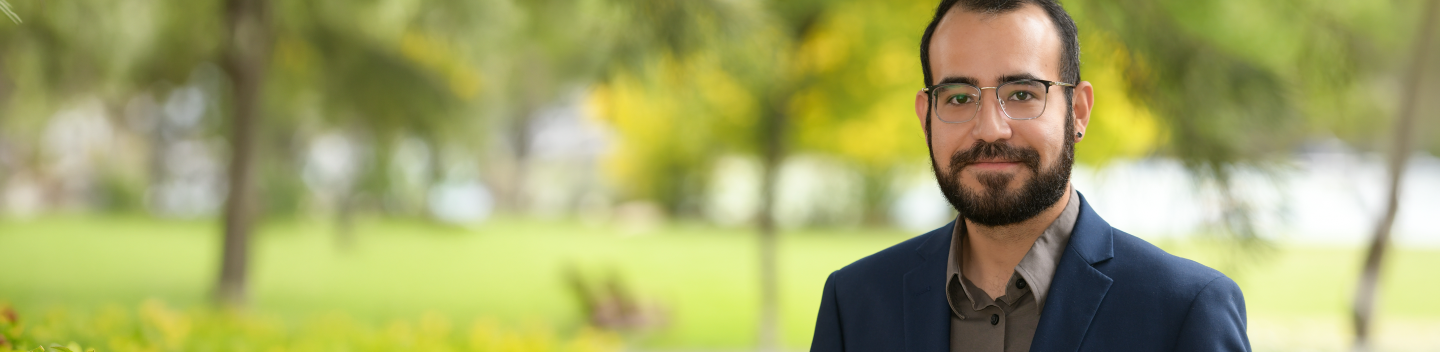
When José L. Godínez Castellanos was just 7 years old, he witnessed something that seemed almost magical.
During a visit to a science exhibition at a university in his native Mexico, he watched two liquids as they were mixed together, producing a mass of expanding foam that eventually hardened into a solid. At another exhibit, compressed air sent a plastic bottle soaring like a rocket.
The demonstrations sparked a curiosity that would shape his future.
“When you’re 7, and you look at that, it’s like, ‘Oh, holy moly,’” he said. “It was very impressive. I remember thinking, I want to do that.”
More than two decades later, the Stanislaus State alumnus is conducting advanced research at the University of California, Berkeley, studying materials that could improve energy efficiency.
A first-generation college graduate who earned his bachelor’s degree in chemistry from Stan State in 2019 and later a doctorate from the University of Southern California, Godínez Castellanos was named a 2025-26 Chancellor’s Postdoctoral Fellow in UC Berkeley’s Department of Chemistry.
His journey reflects the power of educational opportunity, faculty mentorship and perseverance. Now, he hopes to inspire other young people to discover how they can have a future in science.
Finding a Path to Higher Education
When he was 14, Godínez Castellanos moved from Jalisco, Mexico, to the United States, where he attended Oakdale High School.
Although he loved science and imagined teaching someday, he had little understanding at the time of how to pursue higher education.
His parents grew up in rural Mexico, where financial circumstances forced them to leave school after sixth grade and begin working. Despite their limited educational opportunities, they encouraged their son to pursue his dreams.
“My parents didn’t have a chance to go to high school,” he said. “Despite that, they continued pushing me toward getting a better education and following my dreams. They worked so hard for all those years to help me through my education.”
As a first-generation student, he faced a challenge familiar to many students whose families have little experience with college — not knowing what opportunities exist or how to pursue them.
“I just didn't know what type of opportunities were out there,” he said. “And if you don't know what's out there, then you really cannot try to push for it.”
At Stan State, faculty members helped him discover those opportunities. During his first year, Godínez Castellanos took an interest in quantum mechanics, which explores how matter behaves at the atomic level.
Chemistry faculty member Claudia Brackett encouraged him to explore undergraduate research and introduced him to Professor of Chemistry Elvin Alemán, whose work involved observing molecules through specialized microscopes.
Within a couple of months, Godínez Castellanos joined Alemán's laboratory, investigating how DNA damaged by ultraviolet light is repaired. Using fluorescent markers and specialized imaging techniques, he studied molecular changes associated with the repair process.
The experience taught him to develop hypotheses, design experiments and interpret results — skills that would prove essential in graduate school.
“What matters for a Ph.D. is learning how to do research,” he said. “It’s knowing how to be able to go into the lab and come up with a series of experiments or hypotheses. Making a connection with the faculty and having the research experience matters. And that’s what I actually got from Stan State.”
He also found a close-knit academic community. Smaller upper-division classes allowed him to build relationships with professors who knew students by name.
“What I really liked about being at Stan State is that because the classes are so small, you can really make connections with the faculty,” he said.
He fondly remembers gathering with fellow chemistry students in a third-floor conference room in Naraghi Hall to study, exchange ideas — and he admitted they would occasionally talk more than they worked.
Those relationships helped him develop the confidence to pursue opportunities beyond the Central Valley.
Prepared for New Possibilities
After graduating from Stan State, Godínez Castellanos pursued his doctorate in physical chemistry at USC.
Like many first-gen college graduates heading to graduate studies, the transition brought moments of self-doubt. He questioned whether he could compete with peers from more prominent institutions, and he said that many students from smaller universities felt the same way. But he soon felt confident that his undergraduate research experience had prepared him.
“A molecule is a molecule here and there, and it doesn't matter,” he said.
Although he experienced imposter syndrome, he succeeded in his coursework and research, completed his doctorate and continued his scientific career at UC Berkeley.
“I’m definitely very happy and proud of where I am,” he said.
He also acknowledged that many students enter higher education with different financial resources, professional connections and academic support. For those navigating college without those advantages, mentorship paired with tenacity can make a lasting difference.
“You can still achieve it if you put the hard work into it,” he said. “I think it really depends on having perseverance and resilience no matter what the challenges are that you may face.”
Exploring the Science of Energy Efficiency
At UC Berkeley, Godínez Castellanos studies thermoelectric materials, which can convert heat into electricity.
The research has the potential to contribute to more efficient energy technologies, particularly as large data centers and artificial intelligence systems increase electricity demand.
Data centers generate substantial heat as their servers process information. Thermoelectric devices could capture some of that heat, and rather than have it go to waste, it could be converted into usable electricity.
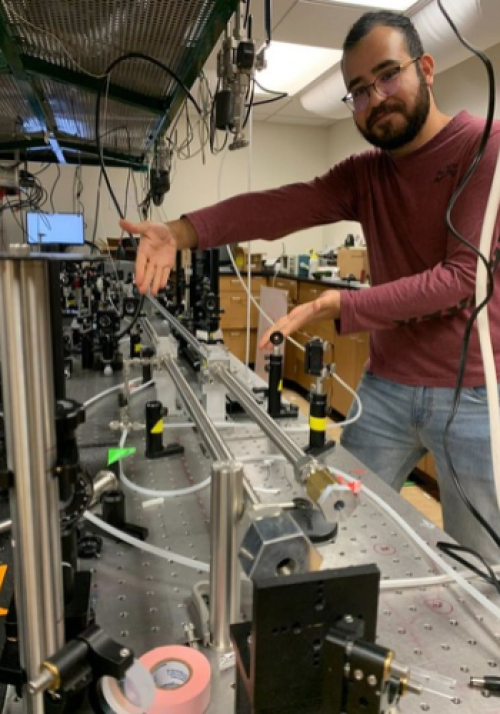
Using advanced microscopes and ultrafast lasers, Godínez Castellanos investigates how heat and electrical charges move through materials at extraordinarily small scales and incredibly fast speeds.
By understanding how a material’s composition and structure affect energy movement, researchers could eventually help develop more efficient thermoelectric technologies.
For Godínez Castellanos, the work combines his fascination with understanding how matter behaves with the opportunity to contribute to future energy solutions.
Inspiring the Next Generation
Godínez Castellanos has never forgotten the science exhibition that captured his imagination as a child.
At Stan State, he helped create similar experiences for Central Valley children by participating as a volunteer for science outreach activities, including Science Day.
He recalls teaching children how to recycle paper and watching their excitement when he invited them to operate a paper shredder. Nearly everyone rushed forward for a turn to use the shredder — something that might seem ordinary for adults, but exciting for the elementary students who were eager to try something new.
“You get to meet all the little children and do experiments and blow their minds,” he said.
Today, he continues encouraging young people through Letters to a Pre-Scientist, a program that connects professional scientists and students through letters sent by mail.
He believes getting to know scientists who share their backgrounds can help children envision opportunities they might otherwise never consider.
“Finding role models who look like you is really important,” he said.
Godínez Castellanos hopes to become a university professor, establish his own research laboratory and mentor aspiring scientists, just as faculty at Stan State and his subsequent universities mentored him.
He says it is also important to him that his accomplishments honor his parents’ sacrifices and demonstrate what education can make possible for first-generation college students.
“I want people to know that people like me, people with my background, can achieve these types of things,” he said.
Years after a science demonstration in Mexico inspired curiosity in a young future scientist, Godínez Castellanos is now helping other young people dream big futures of their own.