When James Youngblom asked Tricia Van Laar to stay after genetics class at Stanislaus State more than two decades ago, the undergraduate thought she was in trouble.
Instead, her professor had a question: Had she ever thought about doing research?
At the time, Van Laar was a 20-year-old transfer student who loved genetics and pictured herself working in forensic science, like the investigators on the TV show “CSI.” She had never considered research.
Youngblom invited her to help study the genetics of an endangered species, introducing her to scientific work she had never imagined doing and helping her develop laboratory skills along the way.
“I worked with him on a project involving endangered brush rabbits, which was not at all like CSI,” Van Laar said. “I applied those things to conservation biology instead of catching bad guys or diagnosing diseases. I had no idea that was possible.”
Youngblom encouraged her to enter the University’s undergraduate research competition, which she won. He also opened her eyes to an entirely different way of approaching science.
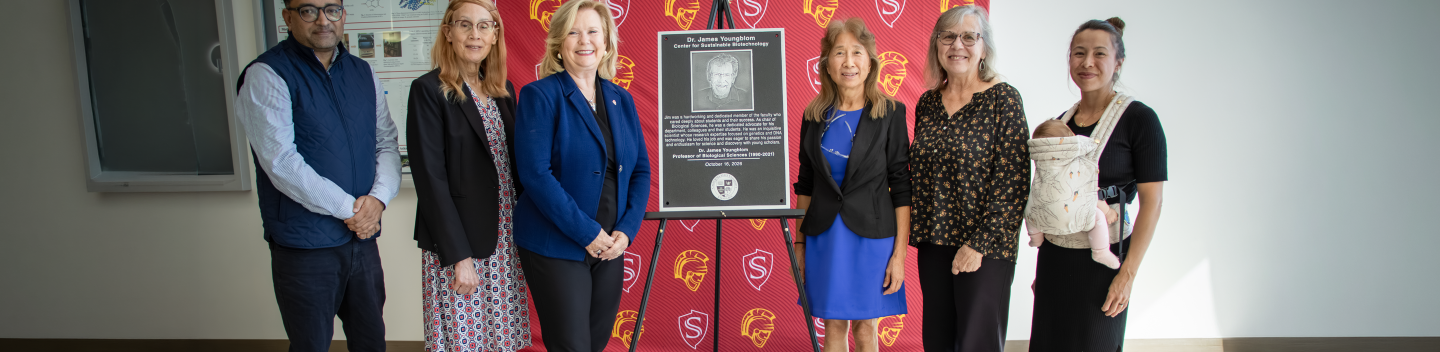
For Van Laar, ’05 biological sciences, that experience opened a path to graduate school and a career as a professor. It also offers a glimpse of the legacy the University celebrated on Oct. 16 with the dedication of the Dr. James Youngblom Center for Sustainable Biotechnology in the Nora and Hashem Naraghi Hall of Science.
Youngblom’s vision inspired Alok Arun, an associate professor of biology at Stan State, during Arun’s faculty recruitment visit to campus. Arun later led the center’s development and wrote the grant to secure $435,000 funding from BEAM Circular. A central goal was to create opportunities for Stan State undergraduates to gain meaningful, hands-on research experience using advanced biotechnology equipment.
Named in honor of Youngblom, who chaired the Department of Biological Sciences and served the University for 31 years, the center expands opportunities for biotechnology training, faculty-guided research and connections to emerging industries in the Central Valley. More than 24 undergraduate students across STEM disciplines are conducting experiential learning research with Arun at the center.
The center also supports graduate student research, with plans to offer summer workshops for K–12 teachers and students and contribute to a regional biotechnology workforce development. The initiative brings together support from the Youngblom family, donors to the James Youngblom Memorial Fund and the University’s partnership with BEAM Circular.
The kind of hands-on, scientific work the center is designed to support can be seen in the projects of two Stan State students exploring potential applications of algae in cancer research and nutrition.
Ema de Alba, a third-year Stan State student from Los Banos majoring in psychology and minoring in biology, uses laboratory equipment to prepare extracts from bull kelp and test how the extracts affect cultured colorectal and thyroid cancer cells. She credits Arun with encouraging her to minor in biology and pursue research outside her major.
“I think internships and opportunities to visit the lab allow students to see different perspectives of biology and science,” de Alba said.
Xochitl Ramirez, a second-year biology graduate student from Modesto, is investigating whether modifying light conditions can
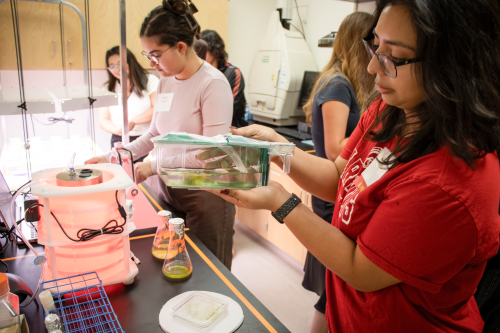
stimulate an algae species to produce higher levels of lipids with potential nutritional value as omega-3 supplements. Her research addresses an important challenge: These compounds are naturally produced in quantities too small to meet the growing need for additional nutritional supplements and to support further scientific investigation. The center provides more laboratory workspace and access to equipment, allowing students to conduct their research more efficiently.
Ramirez earned her bachelor’s degree in biology from Stan State in 2025 and returned for graduate school after receiving acceptances from Cal State Long Beach, CSU Monterey Bay and Cal State LA.
“I came here and I fell in love,” Ramirez said. “I loved it so much I came back.”
From Proposal to Partnership
The center grew from an earlier proposal to renovate a small science laboratory. During the dedication, Janey Youngblom, professor emerita of biological sciences, credited their daughter Emily with encouraging the family to pursue the effort, remembering her father’s enthusiasm for improving the space, citing Emilhy’s recollection of her father’s enthusiasm for improving the space. Contributions to the memorial fund helped support that vision.
Through its partnership with BEAM Circular, Stan State is connecting biotechnology education with the region’s developing circular bioeconomy, which seeks to transform agricultural and organic materials into new products and economic opportunities. BEAM Circular representatives attended the dedication, as did Arun.
The renovated center features specialized technology for hands-on biotechnology education and research. Its resources include a next-generation MinION sequencing platform, an advanced microscopy facility, photobioreactors and real-time quantitative PCR machines, along with platforms for bioinformatics computing, biomolecular characterization and robotics-based molecular biology.
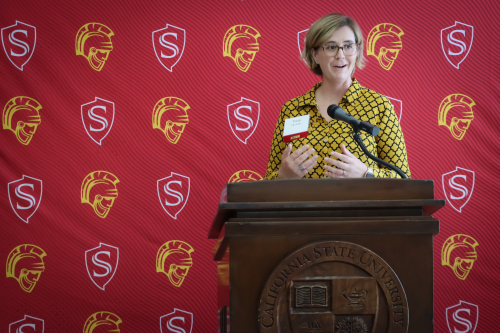
During the ceremony, College of Science Dean Martina Ramirez emphasized the importance of connecting classroom learning with real-world applications.
President Britt Rios-Ellis referenced Youngblom’s expertise in genetics and DNA technology, saying his passion for teaching and mentoring students was “very much in his DNA.”
Van Laar understands that influence personally. Youngblom encouraged her to pursue graduate education and took her to a biotechnology conference. Years later, she attended the same conference during her first year as a faculty member at Fresno State, this time bringing students of her own. There, she encountered her former professor and told him she had become a professor, too.
Following Youngblom’s passing in 2021, Van Laar learned of a faculty opening at Stan State and applied. She eventually returned to the University where he had helped shape her career. Today, she teaches one of his former courses, involving students in research and helping them pursue opportunities to publish their work, just as he did.
“I know how important it was to my career and how meaningful that experience was,” Van Laar said. “So, I try to give that to students, too.”
Janey Youngblom also reflected on how her husband would have reacted to the dedication of a center bearing his name.
“I am sure Jim is beaming with joy right now,” she said, “and he would definitely be chuckling at the pun.”