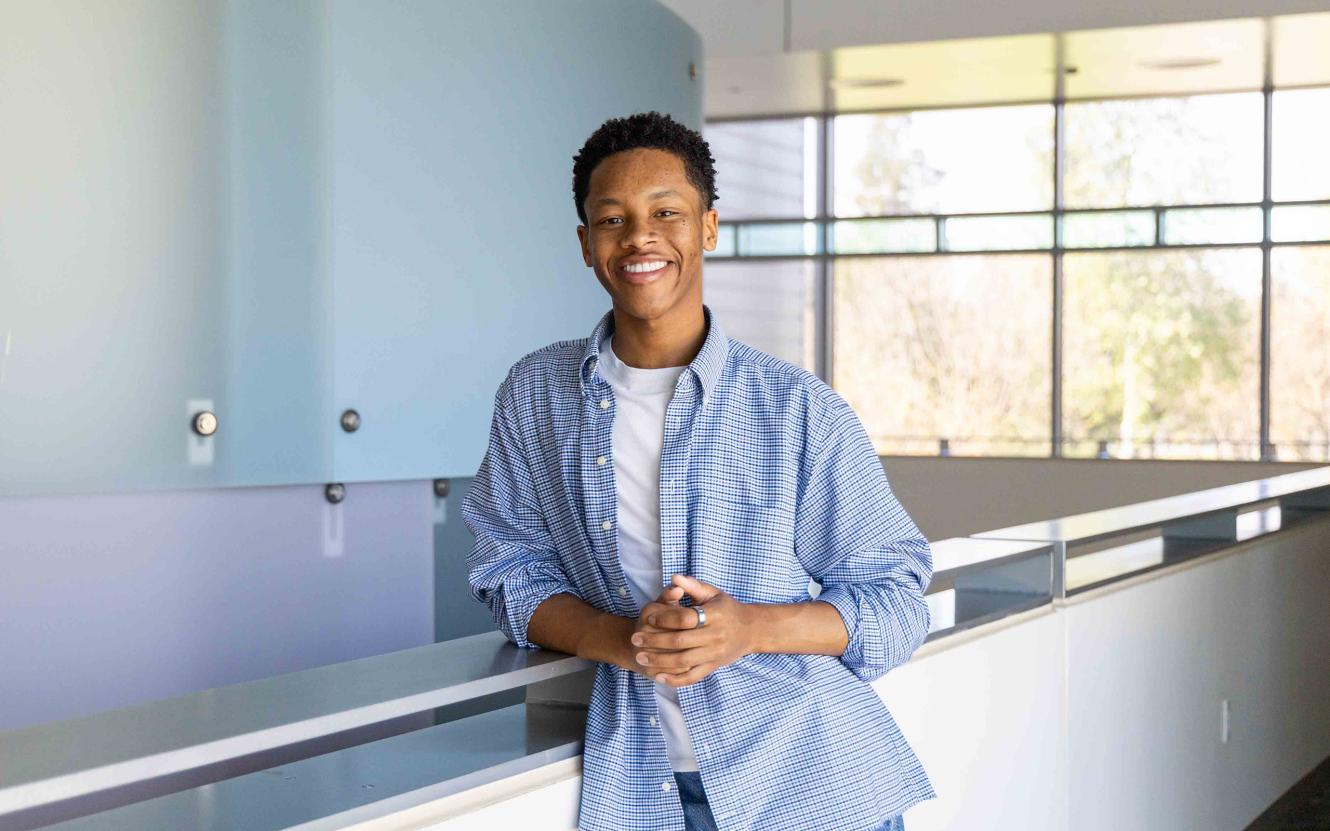
Tory Sumbler was working as a medical scribe in a hospital emergency room, documenting charts and listening as doctors and nurses moved quickly from patient to patient, when a woman came in.
“She was going through a sickle cell crisis,” Sumbler said. “And at first, she wasn’t believed.”
In the days and weeks that followed, he kept thinking about that moment, about what it means to be in pain and not be heard, to need help and not be understood. The question stayed with him, following him from the emergency room to Washington, D.C., and back to Stanislaus State: How do you care for people not only in the moment, but in the systems that shape their lives?
A double major in biological sciences and political science at Stanislaus State, Sumbler has spent his college years in the Central Valley looking for answers. Through leadership roles, his work in healthcare and a competitive internship with the Panetta Institute for Public Policy, he is building a path that bridges medicine and policy.
Sumbler didn’t arrive at Stanislaus State with a clear plan.
Like many students, he was figuring things out — what he wanted to study, what direction to take and where he fit. As an Oakland native, his decision to attend Stan State was shaped in part by access and affordability. Both of his parents served in the Navy, and the VA benefits that helped pay for his education made Stan State the right fit.
What changed that trajectory was a series of connections that helped him find both community and purpose.
Through his involvement in the Black Student Union (BSU), where he later served as president, Sumbler found a space where he felt seen and supported.
That almost didn't happen.
During his first semester, Sumbler spent most of his time commuting to class and going home, unaware of the community waiting for him on campus. One day, after one of his classes ended, a tutor invited him to a BSU event.
When he walked in, he stopped.
“There were a bunch of people,” he said. “I was like, ‘Oh, I didn’t know there were Black people on this campus.’”
That night, he met Marvin Williams, director of Stan State’s Disability Resource Services and the students who would become his closest friends. In the months that followed, he kept coming back.
For perhaps the first time since arriving at Stan State, he could picture himself not just participating, but leading.
“It made me want to be involved in creating that same space for other students,” he said. “BSU is the reason why I’m here.”
By the following spring, he had been elected vice president of BSU. Soon after, he helped shape the culture of the organization itself.
He later served as Associated Students, Inc. director of diversity, helping ensure students felt they had a place and a voice at Stan State.
“Tory is a bridge,” said Myisha Butler-Ibawi, interim associate director of Student Success Initiatives at Stanislaus State. “He’s been a bridge between our department, our program and other students. That’s what makes him unique: his ability to bridge spaces.”
Butler-Ibawi saw that quality early. Sumbler and another student leader, Chioma Chibuko, were among the first students she met when she came to Stan State. Together, she said, they helped build the foundation of Black Student Success on campus.
I want to be able to help people in the moment. But I also want to think about how we make it better for the next person who walks in.
— Tory Sumbler, Biological Sciences and Political Science Major
At the African Black Coalition Conference, where Stan State was participating for the first time with only five students, Butler-Ibawi watched Sumbler lead his peers through the campus chant competition.
“Stan State didn’t win,” she said. “But Tory was unapologetic. He made sure his peers felt comfortable to step up, to have fun and to put themselves out there.”
Along the way, mentorship played a critical role. Sumbler credits faculty and staff who encouraged him to pursue opportunities and think more broadly about his goals.
“They pushed me to step outside of my comfort zone,” he said. “Sometimes you need people who see something in you before you fully see it in yourself.”
That encouragement helped lead Sumbler to one of his most transformative experiences: a fall internship in Washington, D.C., through the Panetta Institute for Public Policy.
Working in the U.S. House of Representatives, he supported constituent services, conducted legislative research and gained firsthand exposure to how policy decisions are shaped.
On some days, that meant answering calls from constituents.
On others, it meant sitting in meetings and listening as lawmakers and staff talked about healthcare, housing, education and the ways those issues overlap.
He attended a briefing on pharmaceutical patents, then another on bird flu, listening as doctors, scientists and policymakers debated how to respond.
He stood on the House floor. He sat in the seat of a member of Congress. He held a copy of Thomas Jefferson’s original House rules book in his hands.
The conversations sounded different from the ones he heard in the emergency room. But beneath them, he recognized the same questions: Who gets access? Who gets help? Who gets left behind?
“It helped me connect the dots,” he said. “I was just thinking about health in terms of what we eat or lifestyle habits. But there’s so much more: your environment, finances, housing. Policy has this unique power to influence all of that.”
The internship gave him a new language for what he had already begun to understand: that the care patients receive is shaped long before they ever walk through the doors of a hospital.
“Tory’s commitment, and I believe it will be lifelong, is to have a positive impact on health disparities,” said Stan State President Britt Rios-Ellis. “In so many ways, Tory reminds me of myself at that point in my educational and professional journey — not just because we hold the same or similar types of degrees that span science and humanities but because he is deeply committed to social justice and equally passionate about the health sciences.”
What inspires me most about Tory is the way he connects knowledge with purpose and action and how he is always ready to learn about and advocate for the needs of others. I cannot wait to see all that he will accomplish with his intellect, compassion, leadership and unwavering commitment to improving the lives of others.
— President Britt Rios-Ellis
Back in California, the lessons from the Panetta internship took on new meaning through his work in the hospital emergency room.
There, Sumbler saw firsthand how systemic issues can show up in individual patient experiences, especially for those with chronic conditions like sickle cell disease.
The patient he recalled wasn’t an isolated case. It was part of a pattern that stayed with him and prompted a question: What could he do, now, to make a difference?
In partnership with the American Red Cross, Sumbler organized a blood drive at Stanislaus State focused on supporting patients with sickle cell disease.
“One of his strengths is his ability to connect dots and channel his passions and interests into actionable events, programs and initiatives,” Butler-Ibawi said.
“He’s a self-starter,” she added. “You don’t have to tell him. He knows how to light the fuse and get things going.”
What began as an idea quickly became something larger.
At first, the blood drive was scheduled for 45 appointments.
“I remember I opened my laptop one time in physics because I was getting nervous—the 45 slots weren’t filled,” he said. “Then I woke up the next day, opened it again, and it said 106. I was really shocked.”
Eventually, the event had to be capped at 60 donors.
For a student who once arrived on campus unsure of where he belonged, the response felt like proof of what can happen when people are invited to care and given a reason to act.
For Sumbler, the blood drive was about more than numbers.
“It showed me that even as a student, you can create something that has a real impact,” he said. “You don’t have to wait.”
...Even as a student, you can create something that has a real impact. You don’t have to wait.
— Tory Sumbler, Biological Sciences and Political Science Major
The blood drive became a tangible extension of everything he had been learning about healthcare, policy and the power of community engagement.
Now preparing to walk in Stanislaus State’s Spring 2026 Commencement, Sumbler is focused on what comes next. He plans to complete his remaining coursework in the fall while continuing to build toward a career in medicine.
Looking back, he sees a path he never expected. He came to Stan State because it was the option that made the most financial sense. He stayed because of the people.
“Even rejection is redirection,” he said.
The colleges that turned him away led him to the campus that would shape him most.
“I don’t think I chose Stan State,” he said. “Stan State chose me.”
Now, he plans to build a career at the intersection of medicine and public policy, helping patients directly while also working to change the systems that shape their care.
“I want people to be inspired by his greatness, but not lose sight of who he is,” Butler-Ibawi said. “He is a human being who needs love, support and care.”
At Stan State, academic study, leadership and experiential learning have come together to help him define not only what he wants to do, but who he wants to be: someone who listens, who leads and who refuses to look away when people are not being heard.
“I want to be able to help people in the moment,” Sumbler said. “But I also want to think about how we make it better for the next person who walks in.”